
Crude Oil Price USD Live in 2026: Your Essential Guide to a $100+ Market
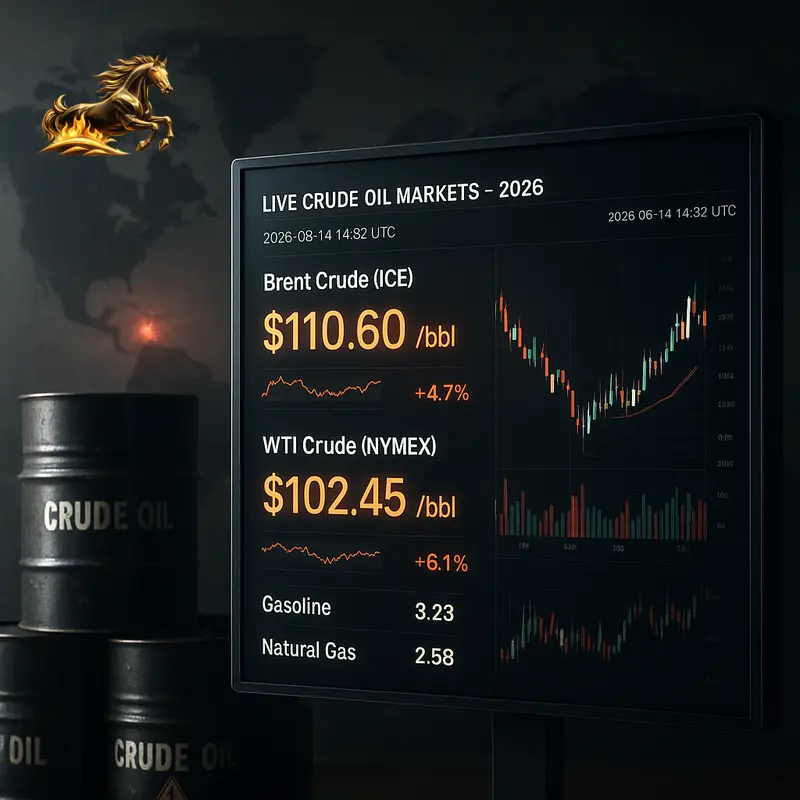
In 2026, the crude oil price USD live has become more than just a number flashing on screens—it’s a crucial barometer of global economic stability. No longer reserved for energy traders or economists, tracking crude oil prices in real time is vital for business leaders, policymakers, and anyone keen to understand the high-stakes environment of today’s energy market. Currently, West Texas Intermediate (WTI) crude trades steadily above $100, hovering around $105–106 per barrel, signaling tightened supply and escalating geopolitical risks on the global stage.
This guide explores the key drivers pushing crude oil prices past the $100 mark, how to effectively interpret live price data, and what the outlook holds for the remainder of 2026 and beyond. Whether you’re managing investments, corporate strategies, or just following the impact on daily expenses, understanding these trends is essential.
Understanding the 2026 Oil Market: More Than Supply and Demand
While supply and demand remain the core of oil pricing, 2026 sees this balance heavily shaped by geopolitical conflicts and major shifts in the energy landscape. To decode the live crude oil price USD, it’s important to grasp these powerful forces at play.
Key Benchmarks: WTI vs. Brent Crude
Crude oil prices in USD mainly reference two benchmarks:
- West Texas Intermediate (WTI): U.S. benchmark delivered at Cushing, Oklahoma. Known for its light, sweet quality, WTI prices respond strongly to U.S. policy, inventory levels, and infrastructure factors.
- Brent Crude: Drawn from 15 oil fields in the North Sea, Brent sets the global price for roughly two-thirds of internationally traded oil, especially from Europe, Africa, and the Middle East. It’s highly sensitive to geopolitical events and disruptions in maritime shipping.
In 2026, volatility in shipping lanes near the Strait of Hormuz has widened the Brent-WTI price spread as Brent’s supply chains are disproportionately affected.
Current Snapshot: High-Stakes Pricing
As of mid-2026, WTI crude is priced around $105.42 per barrel—up sharply by over 4% in a day and soaring more than 70% year-over-year. This spike reflects the near shutdown of the Strait of Hormuz, a chokepoint handling up to 30% of global maritime oil shipments, cutting an estimated 4 million barrels per day (bpd) from global supply and propelling prices into the triple digits.
The Geopolitical Firestorm: Why the Strait of Hormuz Matters
The Strait of Hormuz—nestled between Oman and Iran—is the heartbeat of global oil transit. In 2026, geopolitical clashes here are driving live crude oil price USD fluctuations every minute.
From Risk to Reality: Strait Shutdown Impact
- Tanker traffic restrictions and soaring insurance costs.
- Extended shipping routes adding weeks of delay.
- Heightened fears of military conflict injecting a sharp risk premium.
These factors have pushed WTI past $100, with prices oscillating between $103 and $106 per barrel, directly affecting global consumers and businesses.
Volatility Fueled by Political Drama
Every headline or diplomatic statement around the U.S.–Iran standoff sends crude prices on rapid swings. This volatile environment creates a new normal where political rhetoric itself moves markets—underscoring how deeply geopolitics now intertwines with oil pricing.
Global Shockwaves: India’s Economic Strain
High prices are not confined to financial markets. India—one of the world’s largest oil importers—faces:
- Currency depreciation driven by soaring import bills.
- Rapid depletion of foreign reserves.
- Persistent fuel inflation exacerbating social and political risks.
India’s situation raises a critical question for 2026: can the market sustain $100+ crude oil price USD levels if major economies start to curb demand due to economic hardship?
Structural Market Trends: The Bigger Picture
While Hormuz dominates headlines, deeper structural issues sustain the price surge.
Vanishing Spare Capacity
Unlike previous decades, OPEC+ spare capacity has nearly evaporated due to underinvestment, political constraints, and technical limits—meaning the market lacks the flexibility to quickly increase supply during crises.
Macroeconomic Forces: Inflation & Dollar Dynamics
- Rising oil costs push inflation higher, escalating production and transportation expenses.
- Central banks hike interest rates in response, potentially slowing growth and oil demand.
- A stronger U.S. dollar usually suppresses oil prices by making them more expensive internationally, but in this crisis, supply shortages override currency effects, keeping prices elevated.
Energy Transition Pressures
Global moves toward renewables and electric vehicles discourage major oil investments. Producers hesitate to fund costly, long-term projects amid uncertainty, curbing supply growth and locking in structural tightness.
How to Track Crude Oil Prices USD Live in 2026
Real-time, reliable data is your compass in this volatile market.
Top Platforms for Live Price Tracking
- Investing.com: Comprehensive live WTI updates, charts, and news feeds.
- TradingView: Advanced technical tools and active trading community insights.
- Trading Economics: In-depth historical data, forecasts, and economic indicators.
Reading the Futures Curve
- Backwardation: Spot prices above futures indicate supply scarcity—common in today’s market.
- Contango: Futures prices higher than spot signal ample supply and storage ease.
In 2026, steep backwardation reflects acute near-term shortages.
Trading Instruments to Know
- Futures Contracts (NYMEX – CL): The primary WTI trading vehicle—best for seasoned traders.
- Oil ETFs:
USO: Tracks daily WTI prices.
UCO: A leveraged 2x WTI price tracker—high risk.
SCO: Inverse leveraged ETF betting on price dips—also high risk.
Remember, leveraged ETFs carry increased volatility and aren’t suitable for long-term holds.
Outlook for 2026–2027: What Lies Ahead?
Analysts expect sustained high prices and ongoing volatility.
Market Projections
- Short-Term: WTI prices to stabilize between $107–108 per barrel by late 2026.
- Next 12 Months: Potential climb toward $124 per barrel amid persistent tensions and limited supply.
Possible Scenarios
- Bullish: Escalation prolongs Strait closure; prices spike to $130–150+.
- Base Case: Partial disruptions continue, diplomatic stalemate maintains prices near $100–120.
- Bearish: Rapid diplomatic resolution lowers prices to $80–90, but supply constraints keep them elevated.
Demand Destruction: The Market’s Balancing Act
Prolonged high prices could slow global growth, reducing demand and easing supply pressures, but at notable economic cost. The oil market’s future hinges on this delicate interplay.
Strategic Takeaways: Navigating the $100+ Oil Era
Crossing $100 per barrel redefines the rules for all market participants.
For Businesses
- Hedge fuel costs to protect budgets from spikes.
- Diversify supply chains to avoid geographic risks.
- Improve efficiency with fuel-saving tech and optimized logistics.
For Investors
- Manage risk carefully with stop-losses and position sizing.
- Diversify exposure beyond crude—consider renewables and service sectors.
- Monitor futures curves for early signals of change.
For Policymakers
- Balance assistance to vulnerable groups with incentives for conservation.
- Strengthen energy security via strategic reserves and diversification.
- Educate the public on geopolitical and structural causes behind high prices.
Key Takeaways
- The 2026 oil market is shaped by intersecting geopolitical turmoil, dwindling spare capacity, and a transitioning energy landscape—all converging to keep crude oil price USD live above $100 per barrel.
- The Strait of Hormuz crisis is the dominant price driver.
- Spare capacity constraints limit quick fixes.
- Expect ongoing volatility linked closely to geopolitical shifts.
- High prices impact global inflation and economic stability, especially in emerging markets.
Stay informed with trusted live data, understand market signals, and align your strategies to navigate this volatile, high-stakes oil market confidently.
FAQs
As of mid-May 2026, WTI trades near $105.42 per barrel, fluctuating between $103 and $106 amid geopolitical uncertainties. Check Investing.com or TradingView for real-time updates.
A critical supply disruption from the near closure of the Strait of Hormuz has removed about 4 million bpd from the market, combined with limited spare capacity and geopolitical tensions.
WTI represents U.S. crude priced at Cushing, Oklahoma, while Brent reflects North Sea oils and acts as the global benchmark. Brent prices are more sensitive to shipping route disruptions, widening their gap with WTI during crises.
Top platforms include Investing.com, TradingView, and Trading Economics—all offering live updates, charts, and market insights.
Prices are expected to remain elevated, with WTI averaging $107–108 per barrel by late 2026 and possibly reaching $124 per barrel in the next year if tensions and supply challenges persist.
Mastering the dynamics of the crude oil price USD live market in 2026 empowers you to navigate volatility and strategize effectively in this $100-plus oil era.
