
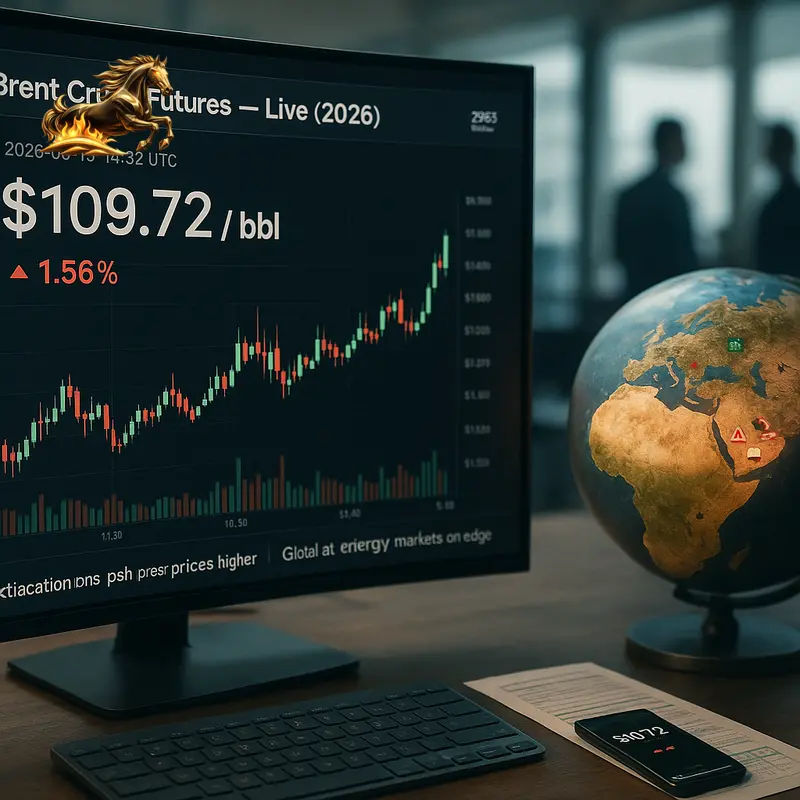
Brent Crude Oil Price Live: Navigating the $109+ Market and Geopolitical Storm in 2026
The Brent crude oil price is much more than just a number on your trading screen—it’s a vital signal of the global economy’s health, geopolitical stability, and energy costs worldwide. In 2026, Brent crude has surged past $109 per barrel, reflecting profound shifts in supply chains, national economic policies, and inflation trends across the globe. This jump isn’t a simple market fluctuation; it stems from layered geopolitical tensions, significant supply disruptions, and refined product market pressures. For traders, policymakers, and consumers, watching live Brent crude price updates is essential for making informed decisions amid ongoing uncertainty.
This article delivers a sharp, real-time breakdown of Brent crude’s 2026 market dynamics. We explore five key drivers fueling the price surge, assess impacts on major economies like India, and decode how refined product markets influence crude valuations. Plus, we share actionable tips on tracking the volatile market live—helping you stay ahead in this fast-changing environment.
Brent Crude at $109+: Decoding the Market Pulse
By mid-May 2026, Brent crude futures have stabilized above $109 per barrel, registering a solid weekly gain of about 8%—well beyond earlier predictions. For instance, Trading Economics had forecasted Brent around $103.40 by quarter-end, demonstrating how current events have defied expectations. This rapid rise highlights a market wrestling with intensified geopolitical risks and real supply constraints few models anticipated.
Prices are not only higher—they’re highly sensitive, reacting swiftly to geopolitical news and trader sentiment. Platforms like Investing.com consistently show prices near $109.26, backed by active futures trading on ICE. This live pricing reflects the combined impact of intersecting crises that layer premium risks across global oil markets.
Why Live Pricing Is Crucial Now
Under typical conditions, daily price changes are moderate. But in 2026, with the Strait of Hormuz—responsible for around 20% of global oil shipments—effectively closed, real-time Brent pricing becomes indispensable as a market barometer. Live prices offer immediate insight into:
- Market reactions to geopolitical developments.
- Inflation pressures and currency impacts tied to energy costs.
- Refiners’ procurement strategies in a tightening market.
Ignoring live price updates risks costly decisions based on outdated info—dangerous in today’s volatile energy landscape.
Five Forces Driving Brent Crude Above $109 in 2026
The Brent price surge past $109 is fueled by several high-impact, simultaneous factors. Understanding these helps anticipate near-future trends.
1. Prolonged Supply Shock from Strait of Hormuz Closure
The main driver is the ongoing closure of the Strait of Hormuz, a strategic chokepoint for Kuwait, Qatar, UAE, and crucial Saudi oil exports.
- Market Impact: This shutdown sharply curtails supply, triggering a severe deficit and a persistent supply shock rather than a short disruption. This scarcity pushes Brent prices up, stoking inflation especially in energy-reliant economies.
- Live Pricing Importance: Each price shift reflects evolving assumptions about how long the closure will last—any news of reopening drops prices, while escalations send them soaring.
2. Stalled US-Iran Talks Elevate Geopolitical Risks
The halt in US-Iran negotiations has increased political uncertainty. Public US statements warn of fragile ceasefire prospects, heightening tensions.
- Market Impact: The diplomatic impasse adds a steep geopolitical risk premium, with Brent hovering between $107–108 as traders price in ongoing disruptions.
- Live Pricing Importance: Brent closely tracks political developments; positive talks ease prices temporarily, while threats trigger rapid jumps.
3. India’s Growing Oil Import Strain
India, a top crude importer, grapples with rising Brent prices driving up import bills, weakening the rupee, and pressuring budgets.
- Market Impact: Policymakers face challenges such as potential fuel price hikes that threaten growth and inflation targets. Reduced demand from India may ultimately soften Brent’s rally.
- Live Pricing Importance: Watch India’s import data and economic signals closely—early demand drops could mark a turning point for prices.
4. European Diesel Shortages Tighten Upstream Pressure
Europe’s diesel market is squeezed by sanctions and supply chain issues, driving prices higher.
- Market Impact: Higher diesel prices boost refinery margins (“crack spreads”), causing refiners to bid more aggressively for Brent crude feedstock—pushing crude prices further upward.
- Live Pricing Importance: Tracking diesel prices helps anticipate Brent moves, since refined product tightness often precedes crude price spikes.
5. Analyst Forecasts Push Price Expectations Higher
Institutional forecasts now set 12-month Brent targets near $116.69 or beyond, reflecting ongoing supply and geopolitical concerns.
- Market Impact: These upgrades fuel investor confidence, encouraging long positions and adding momentum.
- Live Pricing Importance: Forecast revisions amplify volatility and sustain bullish market sentiment.
Why Brent Crude Matters Globally
Brent crude, sourced from the North Sea, serves as a global benchmark due to its light, sweet quality ideal for refining into gasoline and diesel. Around two-thirds of international crude trade pricing relies on Brent, especially for Europe, the Middle East, and Africa. This explains why disruptions like the Hormuz blockade hit Brent harder compared to benchmarks like WTI or the OPEC basket.
How to Monitor Brent Crude Prices Live in 2026
Given today’s volatility, real-time monitoring is a must. Use these tools:
- Investing.com: Live futures prices, charts, and analysis.
- Trading Economics: Combines live data with economic forecasts.
- Oilprice.com: Expert energy news and market insights.
- Financial Times Commodities: High-level updates on commodity flows and refined markets.
Mobile apps like “Oil Price Live” provide instant alerts—essential for seizing market moves.
Beyond Prices: What to Watch
- Geopolitical news from the Gulf region.
- Diesel crack spreads and refined product price trends.
- Economic indicators and import volumes from India.
- Market depth metrics like trading volume and open interest.
Lessons From 2022’s Spike
The 2022 Brent surge above $130 per barrel underscored how chokepoint risks, geopolitical premiums, and demand destruction interact. These past lessons reinforce why robust hedging and risk management remain indispensable in turbulent markets.
Strategic Outlook for Market Participants
For Traders and Investors
- Short term: Expect continued swings, with Brent possibly testing above $115 amid evolving geopolitics.
- Long term: Prices may hold high if supply constraints and diplomatic deadlocks persist, but demand shifts in emerging markets could moderate the rally.
For Policymakers
- Importers: Brace for sustained inflation; diversify supply sources, use strategic reserves, and adjust fiscal policies accordingly.
- Exporters: Seek alternative routes and boost diplomacy efforts to ease chokepoint stresses.
For Corporations and Consumers
- Energy-heavy industries should revise budgets and hedging strategies.
- Consumers should prepare for higher fuel costs impacting overall living expenses.
Brent Crude and the Energy Transition
High oil prices simultaneously incentivize increased production and accelerate renewables’ competitiveness. Brent pricing now increasingly reflects not only supply-demand fundamentals but also policy shifts around carbon pricing and green subsidies.
Quick Takeaways & Recommendations
- Brent surpassing $109 signals a complex crisis: Hormuz closure, stalled diplomacy, India’s import struggles, refined product shortages, and rising forecasts.
- Geopolitical risk premium dominates prices; stability in the Middle East is key.
- India’s demand patterns may moderate price growth.
- Refining market dynamics inform crude price movements.
- Investor forecasts remain bullish, sustaining momentum.
Action steps:
- Build dashboards with live pricing and news feeds.
- Set risk thresholds (e.g., $115 Brent) to guide decisions.
- Stay updated on Gulf geopolitical developments.
- Monitor key importers’ economic data.
- Develop contingency plans to adapt quickly.
FAQs
Q1: Why is the Strait of Hormuz vital for Brent crude?
It handles roughly 20% of global oil trade linked to Brent pricing. Its closure severely cuts supply, driving price spikes.
Q2: How does India’s situation influence Brent prices?
India’s import costs rise with Brent prices, weakening its currency and reducing demand, which can cap further price increases.
Q3: What is a geopolitical risk premium?
An added cost baked into oil prices due to political uncertainties that may disrupt supply beyond current shortages.
Q4: Why do European diesel prices impact Brent crude?
Diesel shortages boost refinery margins, leading to fiercer competition for Brent crude and pushing prices higher.
Q5: Where to find reliable live Brent crude prices?
Futures exchanges like ICE, and aggregators such as Investing.com and Trading Economics, complemented by energy news sources like Oilprice.com.
In summary, Brent crude oil prices in 2026 vividly illustrate the powerful interplay between geopolitics, economics, and product markets unfolding live. By understanding these forces, tapping into real-time pricing, and adopting strategic, informed actions, stakeholders can confidently navigate this turbulent energy landscape. The price you see on your screen tells a rich story of global energy, economy, and diplomacy—changing every moment.
