
Understanding the Share Price of Brent Crude Oil
Introduction
Heading into 2026, Brent crude oil remains a cornerstone commodity influencing global financial markets, economic policies, and geopolitical dynamics. Its price fluctuations grab the attention of investors, corporations, and policymakers alike, given their wide-ranging impact. Whether you’re actively trading or simply curious about global energy trends, understanding the Brent crude oil share price is essential.
In this post, we’ll break down Brent crude oil’s current share price, explore the main factors shaping its price in 2026, and highlight smart investment strategies for this environment. With deeper insight, you’ll be better prepared to read market signals and make informed decisions around Brent crude oil.
What is Brent Crude Oil?
Brent crude oil is a primary type of crude extracted from the North Sea and serves as the global pricing benchmark for roughly two-thirds of the world’s oil trades. It’s widely used on key commodity exchanges, like the Intercontinental Exchange (ICE), offering a transparent and reliable gauge of global oil market conditions.
Why Brent Crude Oil Matters
- Global Pricing Standard: Brent crude sets the benchmark for oil prices worldwide, directly influencing fuel costs across nations.
- Economic Indicator: Its price swings often reflect broader economic factors, including supply-demand imbalances, geopolitical events, and industrial activity trends.
- Investment Vehicle: As a widely traded commodity, Brent crude provides opportunities for portfolio diversification and speculative investment.
Grasping Brent crude oil’s role is foundational for analyzing its share price movements.
The Current Share Price of Brent Crude Oil in 2026
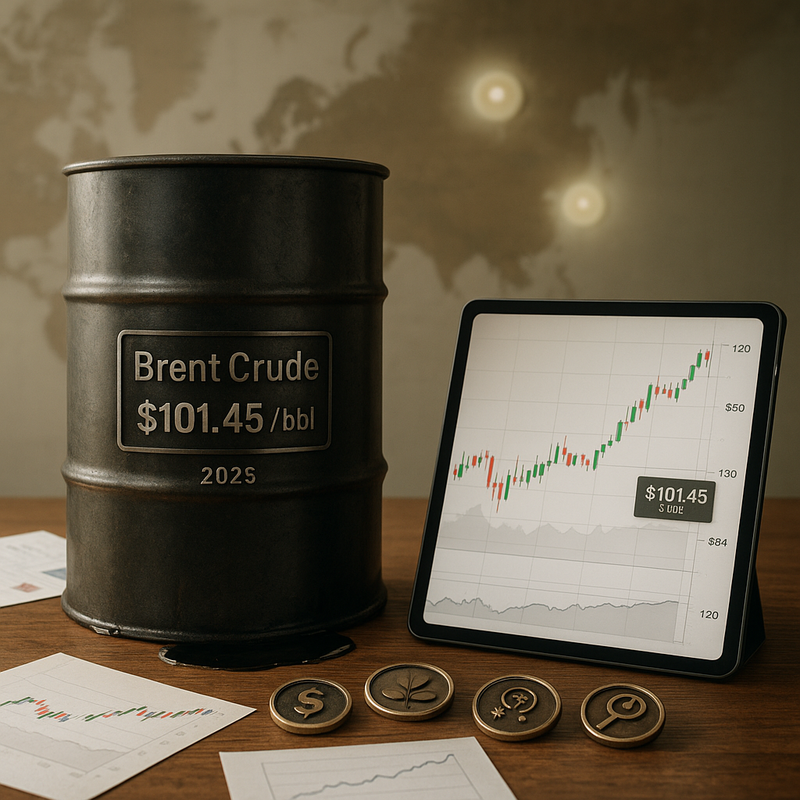
As of 2026, Brent crude oil is trading around $101.45 per barrel. This price reflects a market balancing geopolitical tensions, economic rebounds, and supply considerations. Although slightly down from recent highs near $119.50, the figure underscores ongoing market volatility.
Price Trends at a Glance
- Short-Term Volatility: Over the past year, Brent crude oil has swung extensively—from lows near $58.40 to highs close to $120—driven by supply disruptions and shifting geopolitical landscapes.
- Historical Perspective: Brent prices have historically been volatile, spiking during crises like the 1973 oil embargo and falling sharply in 2014. Post-pandemic demand recovery also contributed to recent price surges.
These trends highlight that Brent crude’s share price is influenced by both immediate events and long-term shifts.
Key Factors Shaping Brent Crude Oil Prices in 2026
Geopolitical Influences
The policies and stability of leading oil producers such as Saudi Arabia, Russia, and the United States heavily sway Brent crude oil prices.
- OPEC Production Controls: OPEC’s decisions on production quotas directly affect global supply levels and, in turn, prices.
- Regional Conflicts: Disruptions in oil-rich areas trigger supply uncertainties, leading to price spikes or dips.
Overall, geopolitical stability is critical to keeping Brent crude prices balanced.
Economic Growth and Oil Demand
Worldwide industrial output and transportation activity drive oil consumption.
- Global Recovery: Economic rebound post-pandemic has lifted oil demand, pushing prices upward.
- Emerging Market Expansion: Rapid growth in economies like China and India continues to boost Brent crude’s demand and pricing.
Typically, stronger economies support higher oil prices, while slowdowns curb consumption.
Environmental Policies and Energy Transition
- Rise of Renewables: Increasing adoption of clean energy technologies is expected to moderate long-term oil demand.
- Regulatory Impact: Carbon pricing and emissions rules may depress oil consumption over time.
Environmental policy introduces both challenges and uncertainties into Brent crude oil price forecasting.
Currency Market Effects
Brent crude oil’s valuation in US dollars means currency fluctuations matter.
- Dollar Strength: A stronger US dollar can make oil costlier for holders of other currencies, reducing demand and pressure on prices.
- Monetary Policies: Interest rates and inflation influence currency values, which indirectly impact oil prices.
Currency dynamics are a subtle yet influential factor in Brent crude’s pricing.
Market Speculation
- Speculative Activity: Traders’ expectations and market sentiment can amplify short-term price swings beyond fundamental supply-demand forces.
Speculation often heightens Brent crude oil’s short-term volatility.
Investment Strategies for Brent Crude Oil in 2026
Navigating Brent crude oil investments requires balancing risk and potential reward. Consider these approaches:
Buying Futures Contracts
Entering oil futures contracts lets investors lock in prices for future oil delivery. This method suits savvy traders familiar with market complexities but carries notable risks due to price swings.
Investing in ETFs
Energy-focused ETFs offer broad exposure to the oil sector, minimizing risks associated with direct commodity trading. They’re a practical way to gain from Brent crude oil price movements without handling futures.
Purchasing Oil Company Stocks
Shares in major oil producers like ExxonMobil or Shell provide indirect exposure to Brent crude prices, often with the added benefit of dividends and less extreme volatility.
Tracking Market and Economic Data
Regularly consulting forecasts from authorities like the International Energy Agency (IEA), US Energy Information Administration (EIA), and International Monetary Fund (IMF) enables more proactive investment decisions.
Diversifying Your Portfolio
Given Brent crude oil’s inherent volatility, spreading investments across different asset types is key to managing risk and smoothing returns.
Choosing the right strategy based on your risk tolerance and market knowledge will enhance your investment outcomes.
Conclusion
Understanding Brent crude oil’s share price in 2026 means recognizing the complex mix of geopolitical events, economic growth, environmental policies, currency fluctuations, and market speculation behind it. With prices hovering near $101.45 per barrel, the market reflects both persistent volatility and important long-term trends.
Investors and analysts who grasp these driving forces and tailor their strategies accordingly will be better equipped to navigate Brent crude oil’s evolving market. Whether through futures, ETFs, or energy stocks, informed decisions pave the way for successful participation in this vital global commodity.
Staying updated with trusted sources and economic indicators ensures you remain prepared to capitalize on opportunities and manage risks as the energy landscape continues to shift in the years ahead.
