
Crude Price Live in Dollars: Your Essential 2026 Guide to Real-Time Oil Markets
In today’s tightly connected world, the crude price live in dollars is much more than just a commodity number—it’s a vital barometer of geopolitical tensions, economic health, and energy security. As we move through 2026, grasping these real-time oil price shifts is crucial whether you’re an investor managing risk, a business driving operations, or a policymaker navigating inflation challenges. This guide delivers a straightforward, comprehensive view of what’s shaping crude oil prices right now and how to decode these market signals effectively.
Understanding Crude Oil Benchmarks: Brent vs. WTI
Before diving into live price updates, it’s key to know the two main oil benchmarks:
Brent Crude, sourced from the North Sea, leads as the global reference price, impacting nearly two-thirds of international oil trade. Its value responds sharply to geopolitical flashpoints across Europe, Africa, and the Middle East.
West Texas Intermediate (WTI) is the go-to benchmark in the U.S., reflecting domestic production mainly from Texas and nearby states. WTI prices move in tandem with U.S. supply data, including weekly EIA inventory reports and infrastructure shifts.
In 2026, Brent and WTI often move on different tracks—Brent reacts strongly to geopolitical risks, while WTI echoes local supply and demand trends. Keeping an eye on both gives you a well-rounded perspective on global and regional crude price dynamics.
The Live Price Landscape in 2026: Navigating Volatility
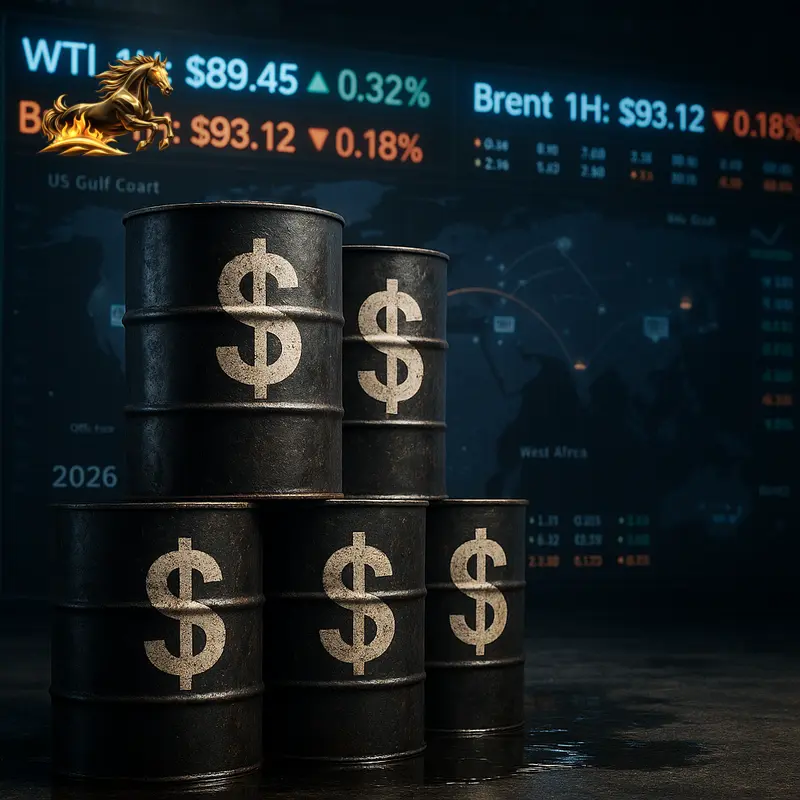
Oil markets in 2026 have been marked by noticeable swings. Brent crude futures surged above $98 per barrel amid heightened Middle East tensions, before settling near $94.13 as conflicts eased. Meanwhile, WTI prices have fluctuated in the high $80s to low $90s range, driven by U.S. shale production and inventory fluctuations.
This volatility mirrors the tug-of-war between supply disruptions, shifting demand, and geopolitical flashpoints—captured in real time by live price tickers that roll with the market’s pulse.
The Key Price Drivers in 2026: From Headlines to Barrels
Geopolitical Risk: A Constant Market Wildcard
- Red Sea Chokepoint: Yemen’s Houthi attacks on vessels linked to Israel disrupt vital shipping lanes, pushing Brent prices higher through added risk premiums.
- Strait of Hormuz: Missile exchanges between Iran and Israel have sparked fears of regional escalation near this critical oil transit route, triggering price spikes that often correct as tensions ease.
Supply Dynamics: OPEC+ Discipline vs. Non-OPEC Output
- OPEC+ Restraint: Despite global uncertainties, OPEC+ has cautiously raised production by only 188,000 barrels per day in July 2026, keeping upward price pressure intact.
- U.S. Shale Resilience: The U.S. continues as the worldwide swing producer. Though shale tech advances boost output efficiency, capital discipline and policies keep production growth moderate, closely influencing WTI prices via weekly data.
Demand Signals: China and Global Economic Trends
- China’s Mixed Recovery: As the largest oil importer, China’s uneven demand—especially among independent refiners—has softened buoyant price momentum.
- Global Economy: Interest rate moves, recession threats, and currency shifts shape worldwide oil consumption prospects, steering price trajectories.
Tracking Crude Price Live in Dollars: Top Tools and Platforms
Accurate, real-time data is a must-have. Leading sources include:
- Financial Terminals: Bloomberg Terminal and Refinitiv Eikon offer ultra-fast, institutional-grade crude price live updates and news.
- Public Sites: Investing.com and Trading Economics provide user-friendly futures charts and analysis for Brent and WTI.
- Commodity News: OilPrice.com and S&P Global Platts deliver in-depth market intelligence and pricing insights.
- Official Data: The EIA’s weekly inventory reports are pivotal for tracking U.S. crude price movements.
When checking prices, match the contract month and type to stay accurate, focusing on front-month futures for best liquidity and relevance.
Why Crude Price Volatility Matters to You
- Consumers: Crude price shifts affect gasoline costs, impacting household budgets and consumer spending patterns.
- Inflation & Policy: Energy prices feed into inflation metrics, complicating central banks’ balancing acts between price stability and growth.
- National Economies: Exporting countries gain from higher prices, while importers face tighter fiscal pressures.
- Businesses & Investors: Price swings challenge budgeting, cost management, and investment decisions across energy-dependent sectors.
2026 Outlook: Steering Through a Volatile Market
While exact forecasts are tough, expect continued fluctuations within an elevated price range:
Bullish Factors:
- Persistent geopolitical tensions in the Middle East
- OPEC+ maintaining cautious output discipline
- Limited investment in new production beyond shale expansions
Bearish Factors:
- Demand softening amid high prices and energy transition progress
- Increased supply from resilient non-OPEC producers
- Global economic slowdowns reducing consumption
Brent crude prices will likely oscillate between mid-$80s to low-$100s per barrel, reacting sharply to unfolding geopolitical and economic news.
Your Action Plan: Mastering Crude Price Live Monitoring in 2026
To stay ahead:
- Track both Brent and WTI to capture complete market dynamics.
- Evaluate news for how it affects supply or demand fundamentals.
- Rely on credible data sources to avoid reaction to rumors.
- Understand your risk exposure to crude price swings.
- Prepare flexible strategies for multiple price scenarios instead of fixed predictions.
Arming yourself with insight into the live crude price in dollars empowers smarter decisions in this vital global market.
FAQ: Crude Price Live in Dollars Made Simple
Q1: What’s the difference between spot and futures prices?
Spot price is for immediate oil delivery, while futures lock in prices for delivery at set future dates, reflecting market expectations and timing.
Q2: Why do prices sometimes drop after conflict news?
Markets often “buy the rumor, sell the news”—prices rise on disruption fears but correct once risk eases.
Q3: How does the U.S. dollar impact crude prices?
A stronger dollar makes oil costlier for other currencies’ holders, usually dampening demand and lowering prices.
Q4: What do backwardation and contango mean?
Backwardation means near-term prices exceed futures, signaling tight supply; contango is when futures are pricier, often indicating oversupply.
Q5: Do renewables affect oil prices now?
Renewables primarily shape long-term demand trends but influence current market sentiment and investment in oil supply.
In the fast-moving and critical oil markets of 2026, understanding the crude price live in dollars is your key to decoding market signals and making informed, strategic decisions amid uncertainty.
