
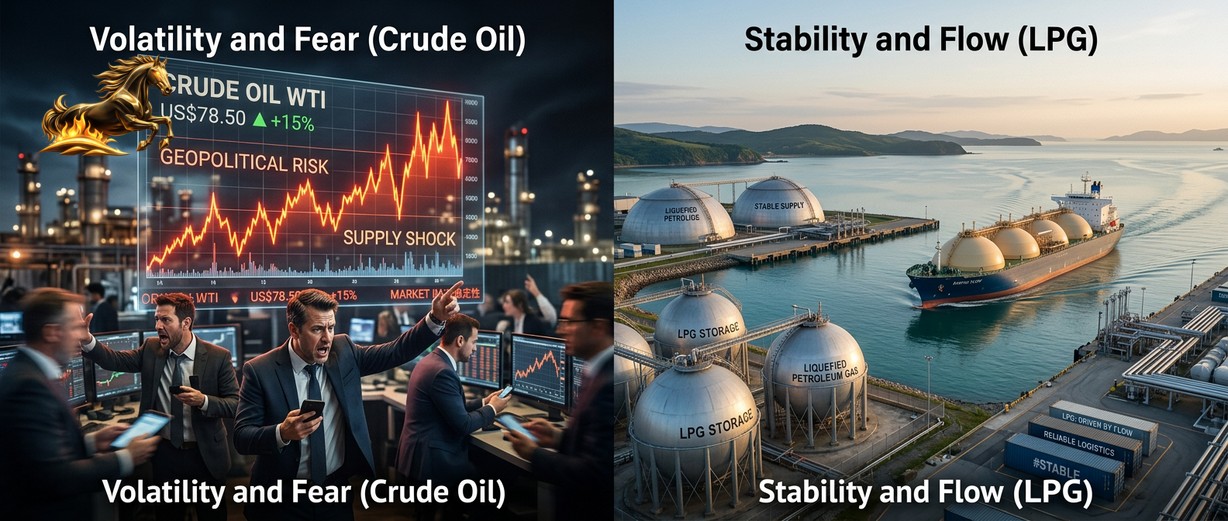
Why Did Oil Prices Soar, Yet LPG Stayed Calm? The Geopolitical Secret Behind Energy Markets
Oil prices often surge dramatically in response to geopolitical shocks—whether missile strikes, sanctions, shipping threats, or sudden tensions in the Middle East—causing Brent and WTI crude futures to spike within hours. These rapid price jumps can happen long before consumers notice any difference at the pump.
Yet, intriguingly, LPG—liquefied petroleum gas, widely used for cooking, heating, industrial fuel, and petrochemicals—rarely shows the same volatile behavior. In many markets, LPG prices stay steady even when crude oil headlines dominate the news.
Why does this happen?
The key lies in how these energy products are priced and traded:
Oil prices react quickly to global market expectations and financial sentiment, while LPG prices depend more on physical supply flows, regional logistics, contractual frameworks, storage, and local market conditions.
Understanding this difference reveals the geopolitical “secret” behind the contrasting energy market reactions. A single geopolitical event can rattle one market instantly, while barely disturbing another at first.
Let’s dive deeper into what drives this phenomenon.
Same Energy World, Different Price Reactions
At first glance, crude oil and LPG appear closely connected:
- LPG often comes from natural gas processing and oil refining.
- Crude oil is the world’s dominant liquid fuel feedstock.
- Both move through a complex network of ports, terminals, shipping, and storage facilities.
- Both face geopolitical risks, especially around major production or transit regions.
So wouldn’t LPG prices jump whenever crude oil spikes?
Not necessarily.
Energy markets are a mosaic of overlapping but distinct systems, each with unique pricing methods, supply chains, demand drivers, and trading behaviors.
Crude oil functions as a highly financialized global benchmark commodity. LPG markets are more fragmented, regionally focused, and strongly shaped by tangible logistics and local supply realities.
That’s why oil prices can soar on anticipation and fear, while LPG often waits for actual supply disruptions to react.
Crude Oil: The Global Geopolitical Alarm Bell
Crude oil is more than just another commodity—it’s a critical economic barometer.
Its price affects:
- Transportation and manufacturing costs
- Inflation expectations
- Central bank monetary policy
- Government budgets and revenues
- International trade balances
- Military logistics and strategy
- Corporate earnings and investments
- Consumer confidence
Because oil is vital to the global economy, it reacts sharply to uncertainty.
When geopolitical risks rise, traders don’t wait for physical shortages—they price in potential disruptions immediately. Oil acts like an alarm bell, ringing before the fire is confirmed.
Why Oil Prices Spike Quickly
1. Oil’s Role as a Global Benchmark
International crude oil pricing centers on benchmarks like Brent, West Texas Intermediate (WTI), and Dubai/Oman crude. Brent, for example, is the primary reference for much of the global oil trade.
Disruptions in key producing or transit regions send price ripples worldwide. Tensions in the Middle East impact traders from London to Singapore nearly simultaneously, triggering rapid, synchronized price jumps.
In contrast, LPG pricing is regional and fragmented. Major references include:
- Saudi Aramco Contract Price (Saudi CP)
- Mont Belvieu propane and butane prices (U.S.)
- Argus Far East Index (Asia)
- Northwest Europe propane and butane assessments
- Domestic wholesale or regulated prices in many countries
This diversity slows LPG’s reaction to broad geopolitical headlines.
2. Oil Futures: Deep, Liquid, and Financially Complex
Oil futures markets involve far more than producers and consumers. Hedge funds, banks, airlines, sovereign wealth funds, commodity traders, and algorithms all drive trading.
Expectations about future supply risks are as influential as current physical balances.
According to the International Energy Agency and World Bank, geopolitical threats amplify oil volatility due to its core role in the global economy.
So, credible risks—not just actual shortages—can send oil prices soaring in a heartbeat.
3. Broad Oil Demand with Low Short-term Flexibility
Oil fuels cars, trucks, planes, ships, machinery, petrochemical plants, and military logistics.
Demand isn’t easily curtailed or substituted quickly, creating sensitivity to supply uncertainties.
4. Exposure to Critical Maritime Chokepoints
Oil trade depends heavily on strategic sea lanes. The Strait of Hormuz alone channels about one-fifth of global petroleum liquids.
Disruptions or threats there—or at chokepoints like the Suez Canal or Bab el-Mandeb—instantly impact oil prices worldwide.
LPG: A Different Energy Market Dynamic
LPG—mainly propane and butane—is essential for cooking, heating, industrial fuel, and petrochemical feedstock.
Despite its importance, LPG price behavior often starkly contrasts with crude oil.
Why?
Because LPG prices mostly reflect physical supply and regional market conditions, not global financial market sentiment.
Why LPG Stays Calm Amid Oil Price Surges
1. LPG Pricing Is Regional and Fragmented
LPG markets operate regionally:
- U.S. propane prices depend on domestic inventories, shale gas liquids production, export capacity, and seasonal heating demand.
- Asian LPG reflects Middle East exports, U.S. supply, freight costs, petrochemical demand, and Saudi CP pricing.
- European LPG relies on refinery output, imports, local demand, and natural gas market conditions.
- Many countries regulate domestic LPG prices or use long-term contracts.
Due to these localized dynamics, global geopolitical shocks often don’t immediately or uniformly affect LPG prices.
2. LPG Hangs on Physical Logistics
LPG requires specialized handling—pressurized cylinders, refrigerated storage, and dedicated shipping vessels.
If regional inventories are healthy and contracts secure, LPG prices remain stable even when crude oil spikes from geopolitical fears.
LPG only moves when physical flows face real obstacles—cargo delays, terminal shutdowns, or shipping disruptions.
3. Diverse Supply Sources Cushion LPG
Unlike crude oil, LPG comes from both natural gas processing and oil refining.
U.S. LPG benefits from shale gas liquids, while Middle East supply blends gas and oil sources.
This diversity weakens LPG’s immediate correlation with crude oil, helping LPG availability stay stable when oil markets tighten.
4. Different Demand Drivers
LPG supports:
- Household cooking
- Residential heating
- Agriculture (like crop drying)
- Industrial fuel and petrochemical feedstock
- Autogas transportation
These demand patterns don’t mirror crude oil’s largely transportation-driven consumption.
5. Price Controls and Contracts Stabilize LPG
Governments often regulate or subsidize LPG prices to keep it affordable, especially for households.
Long-term contracts and pricing formulas further delay or smooth out the impact of global shocks.
The Geopolitical Secret: Oil Reacts to Fear; LPG Reacts to Flow
To sum up:
- Oil prices jump swiftly on the fear of future supply disruptions, fueled by financial speculation and global economic concerns.
- LPG prices respond mainly to actual physical supply chain disruptions—inventory levels, contract changes, shipping, and regional demand.
Geopolitical headlines trigger immediate oil price spikes as traders price risk premiums.
Meanwhile, LPG prices stay calm unless physical logistical issues arise.
A Real-World Example: The Strait of Hormuz
Imagine sudden tensions near the Strait of Hormuz.
Oil traders instantly factor in risks like tanker blockades, export slowdowns, insurance cost hikes, and military escalation.
Oil futures surge.
LPG traders, however, focus on cargo schedules, export terminal operations, inventory levels, contract coverage, freight rates, and local demand.
If physical LPG flows remain steady, prices hold firm despite the geopolitical alarm.
What This Means for Investors, Buyers, and Policymakers
Investors
Knowing the different market mechanics helps avoid conflating oil price moves with LPG.
Effective analysis requires assessing:
- Global benchmarks versus regional pricing
- Futures-driven speculation versus physical contract realities
- Inventory tightness
- Geographic impacts
- Shipping routes and chokepoint status
- Government policies
Energy Buyers
A spike in oil prices doesn’t automatically mean LPG costs will rise immediately.
Buyers should track relevant LPG price indexes, freight rates, inventories, and policy changes to manage risk proactively.
Policymakers
To ensure affordable LPG supply, governments must invest in strategic storage, diversify sources, build robust infrastructure, maintain transparent pricing, and manage subsidies—focusing on physical delivery rather than only global prices.
Key Takeaways
- Crude oil is a global, financialized benchmark commodity reacting rapidly to geopolitical risk perceptions.
- LPG is a regionally segmented, logistics-driven market influenced mainly by physical supply conditions.
- LPG prices often lag oil price spikes unless actual cargo flows or inventories are disrupted.
- Government policies and contracts smooth LPG retail prices amid volatility.
- The “fear” factor moves oil prices; the “friction” factor moves LPG prices.
- Understanding these differences is crucial for market participants.
While crude oil prices quickly incorporate geopolitical fears and market expectations, LPG prices patiently await confirmed physical supply disruptions.
Recognizing the fundamental divide between global financial sentiment and regional logistical realities reveals the secret behind why oil can soar while LPG remains calm—insights essential for investors, buyers, policymakers, and all stakeholders in energy markets.
In energy markets, the rule is clear: fear moves oil; friction moves LPG.
