
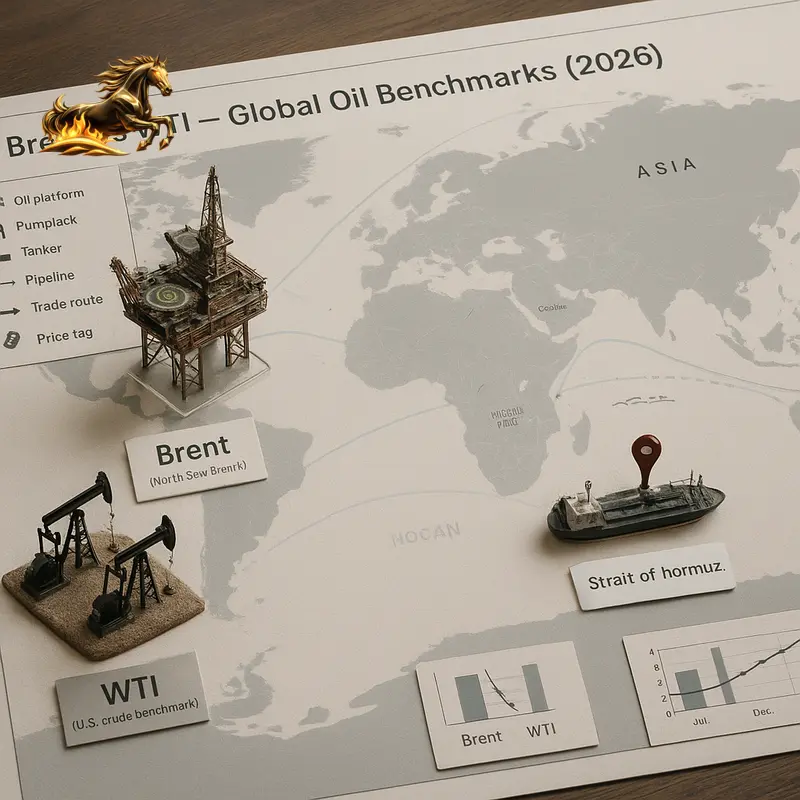
Brent vs. WTI Crude in 2026: Understanding the Global Oil Market’s Twin Pillars
In the dynamic energy landscape of 2026, two crude oil benchmarks stand tall: Brent and West Texas Intermediate (WTI). Though these terms may sound technical, their prices profoundly impact global economies, corporations, governments—and even the fuel you put in your car. With recent geopolitical tensions such as a fragile U.S.-Iran ceasefire and an unprecedented blockade of the Strait of Hormuz, Brent and WTI have never been more relevant. As American crude exports surge to offset Middle Eastern supply disruptions, understanding these benchmarks is key to grasping today’s global oil market and its future trajectory.
This article breaks down Brent and WTI crude oils: what they are, how they differ, and why their prices matter. We also explore the geopolitical developments shaping their behavior in 2026, technological and financial market drivers, and the ongoing global energy transition’s impact. By the end, you’ll gain a clear, nuanced perspective on these twin pillars of global oil pricing—and what that means for markets worldwide.
What Are Brent and WTI Crude? The Market’s Cornerstones
At their core, Brent and WTI are classifications of light, sweet crude oils. “Light” refers to their lower density, and “sweet” to their low sulfur content—qualities that make them easier and cheaper to refine into gasoline, diesel, and jet fuel. Despite these similarities, they differ significantly in origin, logistics, and market role.
Brent Crude: The Global Price Leader
Brent crude is a blend derived from four major North Sea oilfields: Brent, Forties, Oseberg, and Ekofisk (collectively “BFOE”). Being offshore between the UK and Norway, Brent is shipped by tanker, enabling flexible global distribution.
This maritime origin helps Brent maintain its status as the global benchmark for about two-thirds of internationally traded crude, especially from Europe, Africa, and the Middle East. Brent’s price acts as a global barometer, reflecting geopolitical risk, supply shifts, and economic conditions across continents.
WTI Crude: America’s Benchmark
West Texas Intermediate (WTI) primarily comes from inland U.S. oilfields—especially Texas—with Cushing, Oklahoma serving as its delivery hub. Unlike Brent, WTI is landlocked, transported mainly by pipeline or rail to Gulf Coast export terminals.
The U.S. shale boom and lifted export restrictions since 2015 have elevated WTI’s global influence. By 2026, soaring American crude exports have transformed WTI from a domestic standard to a key global benchmark. Still, WTI pricing remains sensitive to U.S. inventory levels and infrastructure, closely tied to domestic energy policy.
Bottom line: While Brent leads as the global price benchmark thanks to its seaborne supply and international reach, WTI has grown into a major global player rooted in U.S. production and export dynamics.
Five Crucial Differences Between Brent and WTI
To fully grasp Brent and WTI, it’s essential to understand their key differences:
- Location and Logistics: Brent’s offshore North Sea origins allow flexible shipping worldwide. WTI’s inland origin relies historically on pipelines and rail but benefits now from increased export capacity.
- Market Reach: Brent dominates Europe, Africa, and Asia’s oil markets. WTI mainly serves North America but steadily expands its global footprint via exports.
- Price Spread: Brent typically commands a premium due to geopolitical risks and ease of export. In 2026, Brent trades near $108/barrel while WTI hovers around $102. This spread widens or narrows based on U.S. inventory, Middle East tensions, and export infrastructure.
- Production Profile: Brent fields are mature and stable, managed by consortia. WTI’s shale production is more price-sensitive and volatile, needing ongoing drilling investments.
- Refining Preferences: Slight chemical differences influence refiners’ preferences, affecting regional demand and pricing.
Insight: Tracking these distinctions helps anticipate price moves and identify vulnerabilities in supply chains.
The 2026 Oil Market: Geopolitics, Supply Shocks & Volatility
The oil market in 2026 is anything but predictable, shaped by geopolitical flashpoints and supply disruptions.
Strait of Hormuz Blockade: A Supply Shock Like No Other
The Strait of Hormuz channels 20–30% of global seaborne oil. Early in 2026, a blockade triggered an “unprecedented supply shock,” per the International Energy Agency, halting much Middle Eastern oil exports. Brent prices surged to $125/barrel—levels not seen in four years—highlighting Brent’s sensitivity to regional instability.
U.S. Export Surge Puts WTI in the Spotlight
Global buyers rushed to the U.S. to fill the void, driving American crude exports to record heights. This boosted demand and prices for WTI-quality oil, establishing the U.S. as a “swing supplier” in the global market, a role once held by Saudi Arabia. This clearly links supply shocks impacting Brent with WTI’s rising global prominence.
Market Whiplash from U.S.-Iran Ceasefire News
Rumors by mid-2026 of a U.S.-Iran ceasefire sent Brent prices dropping swiftly back to $108/barrel, illustrating the market’s extreme sensitivity to geopolitical headlines and the embedded “risk premium” in oil pricing.
Regional Case: India Navigates Complex Market Dynamics
Even with Brent’s sharp rise, Indian oil importers benefited from lower spot premiums thanks to growing supplies from the Atlantic Basin—especially U.S. exports linked to WTI—demonstrating how local market forces modulate benchmark prices.
Summary: Geopolitical shocks don’t just jolt prices; they reshape trade flows and deepen benchmark connections.
Beyond Oilfields: Financial Markets & Technology’s Role
Brent and WTI prices are shaped by more than physical supply—they’re influenced by financial markets and innovation.
Futures Markets: The Price Discovery Engine
Brent futures trade mostly on ICE, while WTI futures are on NYMEX (CME Group). These contracts allow buyers and sellers to lock in future prices, supporting risk management and investment.
New Financial Instruments
Smaller-scale traders now use products like Micro WTI futures and weekly options, adding liquidity and precision in hedging short-term risks. But greater financialization can heighten price swings.
Extraction Technologies Drive Supply
In the U.S., advances in hydraulic fracturing and data analytics keep shale output competitive. The North Sea focuses on extending mature field lifespans and boosting operational efficiency to maintain Brent supplies.
Key point: Physical technologies and financial markets interact in a complex ecosystem influencing oil pricing and supply stability.
The Green Transition and Oil’s Future
Global decarbonization efforts add new layers of uncertainty to Brent and WTI’s outlook.
Steady Oil Demand Despite Renewables Growth
Although renewables and electric vehicles rapidly expand, global oil demand remains above 100 million barrels per day. Hard-to-electrify sectors like aviation and heavy transport sustain strong oil use. Analysts expect a “peak plateau” scenario with demand stabilizing, not plummeting. This environment could heighten price swings due to underinvestment.
Investment Shifts Reflect Transition Risks
Energy companies increasingly juggle oil production with renewable projects and carbon capture. Investors weigh climate risks alongside traditional factors, reshaping valuations and strategy.
Regional Demand Divergence
Developing regions in Asia and Africa likely will see growing oil demand for decades, reinforcing Brent’s importance. North America’s policies and consumption trends will influence WTI’s trajectory.
Takeaway: Brent and WTI remain essential benchmarks amid a shifting economic and environmental landscape.
Key Takeaways for 2026
- Brent as global sentinel, WTI the nimble challenger. Brent leads internationally, shaped by Eastern Hemisphere geopolitics; WTI grows with U.S. supply and export strength.
- Geopolitical flashpoints cause volatility. Events like the Strait of Hormuz blockade dominate price swings, especially for Brent.
- Brent–WTI spread reveals market storylines. Watching their price gap sheds light on inventory, trade, and geopolitical risks.
- Energy transition fuels uncertainty. Demand plateauing suggests ongoing volatility, with light, sweet crude retaining value.
- Physical and financial markets are intertwined. Futures, hedging tools, and tech innovations collectively shape oil’s price and resilience.
Action Points:
- Market professionals should build geopolitical and transition scenarios into risk models.
- Investors ought to monitor benchmark spreads and company strategies using diverse financial instruments.
- Individuals can follow Brent and WTI futures, inventory data, and trusted geopolitical news to stay informed.
Frequently Asked Questions (FAQ)
1. Why does Brent usually cost more than WTI?
Brent’s seaborne supply from geopolitically tense regions adds a risk premium and offers easier global export, pushing its price above landlocked WTI.
2. How do U.S. crude exports affect WTI prices?
Exports reduce domestic oversupply, boosting WTI prices and aligning them more closely with global benchmarks like Brent.
3. What effect does a supply shock like the Strait of Hormuz blockade have?
It swiftly cuts significant oil volumes from markets, driving prices—especially Brent—higher due to regional supply risk.
4. Will renewables cause oil prices to crash soon?
Unlikely. Demand remains strong in sectors hard to electrify. A plateau in consumption increases price volatility via underinvestment risks.
5. How can I effectively follow oil markets?
Track March front-month Brent (ICE) and WTI (NYMEX) futures, monitor U.S. EIA inventory reports, and follow reliable sources covering geopolitical and energy news.
Understanding Brent and WTI crystals more than just oil prices: it reveals deep interconnections between geopolitics, technology, and economics shaping the global energy future. Keeping these twin pillars in view arms stakeholders with the insight needed to confidently navigate 2026’s ever-changing oil market.
