
body {
font-family: “Helvetica Neue”, Helvetica, Arial, sans-serif;
line-height: 1.6;
color: #222;
background: #fff;
padding: 20px 30px;
max-width: 920px;
margin: auto;
}
h1 {
color: #0b4396;
border-bottom: 4px solid #0b4396;
padding-bottom: 8px;
margin-bottom: 30px;
font-weight: 700;
}
h2 {
color: #0a3a6e;
margin-top: 40px;
border-bottom: 2px solid #ddd;
padding-bottom: 6px;
}
h3 {
color: #0760c7;
margin-top: 30px;
}
p {
margin-top: 14px;
font-size: 1rem;
color: #333;
}
ul {
margin-top: 14px;
margin-left: 2em;
color: #444;
}
ul li {
margin-bottom: 8px;
}
strong {
color: #0b4396;
}
blockquote {
border-left: 4px solid #0b4396;
padding-left: 15px;
font-style: italic;
color: #555;
margin: 20px 0;
background: #f4f8ff;
}
hr {
border: none;
border-top: 1px solid #ccc;
margin: 50px 0 35px;
}
.faq-item {
margin-bottom: 20px;
}
.faq-item strong {
color: #06477d;
}
WTI Price Today: Decoding Market Drivers, Risks, and Your 2026 Strategy
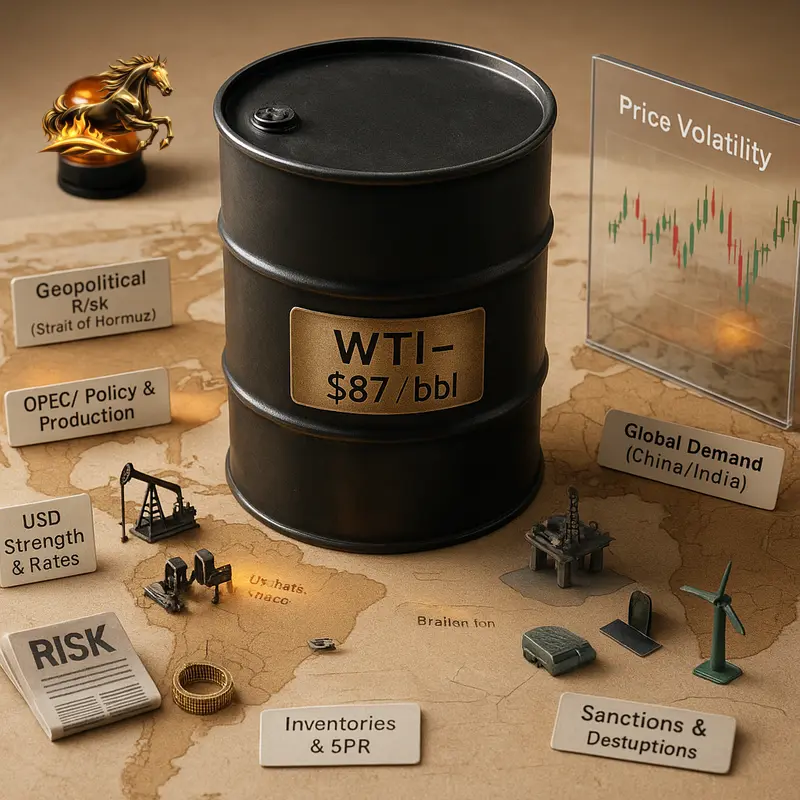
The West Texas Intermediate (WTI) crude oil price is much more than a number—it’s a powerful barometer of global economic shifts, geopolitical risks, and evolving energy trends. Today, WTI trades near $86.64 per barrel, with subtle intraday moves reflecting how traders digest upcoming policy decisions and worldwide developments. This price point tells a complex tale shaped by geopolitical tensions, supply strategies, and changing demand patterns. For investors, business leaders, and policymakers planning for 2026, understanding the key forces behind WTI pricing is essential for crafting smart strategies in a fast-changing energy market.
Why WTI Crude Oil Remains the Essential Benchmark
To grasp today’s WTI price, you need to understand what makes WTI a crucial oil benchmark. Produced mainly in the U.S. and traded on the New York Mercantile Exchange (NYMEX), WTI is prized for its light, sweet profile—low sulfur and easy to refine into gasoline and diesel. The transparent, highly liquid delivery hub in Cushing, Oklahoma, boosts its global significance.
Thanks to the U.S. shale revolution, WTI transformed from a regional marker into a key global benchmark. This evolution has blurred boundaries between domestic and international markets. While Brent crude from the North Sea traditionally carried geopolitical premiums tied to Middle Eastern risks, WTI now increasingly reflects those influences as U.S. exports grow. In 2026, WTI pricing represents a sophisticated blend of local production data, inventory shifts, and geopolitical developments.
Historical Context Behind Today’s Price
WTI’s path has been marked by sharp ups and downs—oil shocks in the 1970s, the 2020 negative price event, and various supply disruptions. Today’s price hovering near $87 per barrel represents a balance shaped by robust U.S. shale output, coordinated OPEC+ supply management, and persistent global uncertainties amid the energy transition. This history adds valuable perspective when reading current market signals.
Breaking Down WTI Price Today: Key Drivers in 2026
The WTI price captures a live tug-of-war between supply constraints, demand pressures, and risk sentiment. Here are the main factors driving prices now:
1. Geopolitical Tensions: The Iran Sanctions Premium
Geopolitical risks remain the top catalyst for price swings, with renewed U.S. sanctions on Iran and tensions in the Strait of Hormuz front and center.
- Impact of Sanctions: Market moves show classic patterns where prices rise ahead of expected sanctions and then retreat as traders take profits. Stricter sanctions risk removing supply, pushing prices upward while adding short-term uncertainty.
- Strait of Hormuz Risks: This crucial shipping lane, with over 660 million barrels transiting since May 2026 under close U.S. oversight, underpins a latent premium in oil prices—especially visible in the Brent vs. WTI price gap.
- WTI-Brent Spread: The nearly $7 difference between Brent (~$94.39) and WTI (~$87.06) highlights a geopolitical risk premium baked into Middle Eastern-linked crudes. This spread is a key signal for traders assessing supply risk zones.
2. Supply Dynamics: OPEC+ Discipline and U.S. Production
Supply-side management continues to shape price discovery.
- OPEC+ Coordination: Led by Saudi Arabia and Russia, OPEC+ expertly balances output to sustain price targets, carefully avoiding excessive swings. This discipline supports global floor pricing.
- U.S. Shale Sector: In 2026, shale producers emphasize capital efficiency over volume growth, fostering a steady supply backdrop that tempers wild price swings.
3. Economic Recovery and Changing Demand
Demand dynamics are the other half of the story.
- Post-Pandemic Recovery: Global consumption has bounced back to pre-pandemic levels, driven especially by emerging markets’ industrial and aviation sectors.
- Macroeconomic Factors: Inflation controls and interest rate hikes influence economic momentum and energy demand, keeping market watchers alert to central bank policies.
- Electric Vehicle (EV) Adoption: Steady EV growth in major economies gradually curbs gasoline demand, affecting long-term peak oil forecasts.
4. The Green Energy Shift and Policy Impacts
Energy transition policies increasingly pressure oil markets.
- Government Action: Renewables mandates and carbon reduction incentives are steering investment flows and corporate strategies.
- Carbon Pricing: Added costs from carbon regulations affect refining margins and crude preferences.
- Strategic Petroleum Reserves (SPRs): SPR releases serve as tactical levers to ease price volatility, adding complexity to supply-demand balances.
5. Technology and Market Intelligence
Technological advances enhance both supply efficiency and market clarity.
- Enhanced Extraction: New drilling methods keep break-even costs low, maintaining production during moderate prices.
- Real-Time Analytics: AI and satellite data enable faster insights, fueling quicker and occasionally sharper price moves.
How WTI Prices Impact Economies and You
WTI price shifts ripple through consumer wallets, businesses, and the broader economy.
For Consumers
Fuel price fluctuations influence gasoline at the pump, heating bills, and prices on petroleum-based goods. Sustained WTI above $80 tightens household budgets and adds inflationary pressure.
For Businesses
- Transportation: Airlines, shipping, and trucking see profits squeezed or expanded by fuel cost volatility.
- Manufacturing and Chemicals: Oil-dependent input costs impact production expenses and competitiveness.
- Agriculture: Oil-linked expenses for fertilizer and machinery affect food prices downstream.
For Energy Sector and Investors
- Profitability: Producers’ cash flows and investment plans respond directly to price levels.
- Portfolio Management: Energy market moves influence valuations across stocks, bonds, and commodities.
- Transition Investing: Oil prices affect the economics of renewable energy investments, shaping the pace of the energy transition.
How to Strategically Navigate WTI Price Volatility
Staying ahead means proactive planning.
For Businesses: Hedging and Resilience
- Use Hedging: Futures, options, and swaps lock in costs to protect budgets.
- Boost Efficiency: Energy-saving and supply diversification build operational strength.
- Diversify Energy Sources: Integrate renewables and alternative fuels to reduce oil exposure.
For Investors: Deep Analysis and Diversification
- Analyze Thoroughly: Look beyond prices—consider futures curves, inventories, and spreads.
- Diversify Across Energy: Balance holdings across upstream, midstream, downstream, and renewables.
- Embrace Thematic Investing: Play the energy transition themes to hedge for long-term demand shifts.
For Policymakers: Balancing Security and Green Transition
- Maintain Energy Security: Keep strong strategic reserves and stable supply routes.
- Manage Inflation: Monitor oil-driven inflation and mitigate its effects.
- Support Transition: Incentivize clean energy to reduce future risks.
Outlook: What Lies Ahead for WTI in 2026 and Beyond
Predicting precise prices remains tough, but watch these factors closely:
- Iran Sanctions Enforcement: How tightly sanctions are applied will affect supply availability.
- OPEC+ Unity: Production decisions amid fiscal pressures will influence supply.
- Global Growth: Avoiding recession is key to stable demand.
- Unexpected Shocks: Geopolitical or weather-related disruptions remain risks.
- Energy Transition Speed: Technology breakthroughs could reshape long-term demand faster.
Expect ongoing volatility, likely within an $80 to $95 band, reflecting the delicate balance of geopolitical risks, supply discipline, demand fundamentals, and energy transition uncertainties.
Conclusion: Master the WTI Market with Informed Strategy
Today’s WTI price near $87 reveals a complex, evolving energy system. Knowing the geopolitical pulse, supply-demand fundamentals, and transition trends gives investors, businesses, and policymakers the confidence to navigate WTI price volatility wisely.
Key Takeaways:
- Monitor Geopolitical Hotspots: Stay updated on Iran and the Strait of Hormuz.
- Track Fundamental Data: Use EIA inventory reports and OPEC+ announcements.
- Manage Risk Proactively: Employ hedging and improve operational resilience.
- Think Long-Term: Factor in global energy transition dynamics.
WTI crude oil remains fundamental to economic and geopolitical landscapes. Smart, informed strategies will keep you ahead in this changing market.
FAQ: WTI Price Today
WTI (West Texas Intermediate) is a premium, light, sweet crude produced mainly in the U.S., benchmarked globally due to its quality and the transparent Cushing, Oklahoma hub.
Markets often “buy the rumor, sell the news”—profiting on expected sanctions before a pullback when those sanctions actually occur.
The roughly $7 spread signals a geopolitical risk premium on Brent crude, tied to Middle Eastern supply risks, while WTI is more insulated, reflecting regional supply-demand differences.
Production cuts or increases by OPEC+, led by Saudi Arabia and Russia, influence global oil supply, pushing WTI prices up or down accordingly.
Use reliable sources like Bloomberg for real-time tracking, weekly EIA inventory reports for fundamentals, and OPEC/IEA insights. Watch inventory levels, rig counts, and OPEC+ announcements for a full market picture.
