

“`html
US Brent Oil Price in 2026: Expert Analysis and Actionable Forecasts
Every morning, financial markets wake up to one crucial number—the price of oil. Among global benchmarks, few carry more weight than the US Brent oil price, a pulse check on energy markets that impacts everything from gas pumps to stock portfolios. As we analyze market trends in 2026, Brent crude remains firmly in the spotlight, swayed by geopolitical tensions, supply shocks, and the accelerating energy transition.
Recent volatility underscores its influence—Brent spiked above $100/barrel amid Middle East conflicts before retreating below $90 as risks eased. These aren’t abstract fluctuations; they dictate inflation rates, corporate earnings, and household budgets worldwide.
This deep dive unpacks the Brent crude forecast for 2026. We’ll decode the economic, political, and technological forces shaping prices—and reveal strategic insights for traders, businesses, and policymakers navigating this high-stakes market.
Brent Crude Decoded: The Global Benchmark Explained
Why Brent Sets the Gold Standard
Brent crude—light, sweet oil from the North Sea—is the world’s most watched oil benchmark. Two-thirds of globally traded crude prices align with it. Key reasons for its dominance:
- Unmatched Liquidity: Over 1 million Brent futures contracts trade daily.
- Geopolitical Sensitivity: Reflects supply risks from the Middle East to Russia.
- Pricing Power: Most international contracts use “Brent +/-” pricing models.
Even for the US—where WTI (West Texas Intermediate) dominates—Brent prices heavily influence import costs, export revenues, and pump prices nationwide.
From $30 to $100+: Brent’s Turbulent Journey
Price History’s Hard Lessons
- 2016: Prices crashed below $30 amid a US shale glut.
- 2020: COVID lockdowns briefly pushed futures to negative values.
- 2024: Prices oscillated between $80-$100 on OPEC+ cuts and recession fears.
Three patterns emerge:
- Geopolitics is the ultimate wildcard (see: 2024’s $20 swings in weeks).
- OPEC+ still moves markets, but US shale acts as a counterbalance.
- Demand shocks (recessions, efficiency gains) cut deeper than supply ones.
2026 Outlook: 5 Forces Shaping US Brent Oil Prices
1. Geopolitical Tinderboxes
- Middle East: Attacks on infrastructure could instantly spike prices.
- Russia/Ukraine: Sanctions and transport disruptions remain risks.
- Venezuela/Iran: Potential supply wildcards if sanctions ease.
2. The Green Transition’s Double-Edged Sword
- EV adoption is accelerating, but global oil demand still hit record highs in 2024.
- Emerging economies (India, SE Asia) will drive 75% of demand growth through 2030.
3. OPEC+ vs. Shale: The Supply Chessboard
- OPEC+ discipline supports prices, but members cheat quotas when prices rise.
- US shale’s break-even is now ~$60/barrel—keeping a lid on runaway rallies.
4. Economic Growth vs. Recession Risk
- Soft landing? Resilient growth could sustain $90+ Brent.
- Global recession? Prices could revisit $70s as in 2016/2020.
5. USD Strength & Financial Markets
- A stronger dollar (likely with Fed rate cuts) typically pressures oil prices.
- Speculative trading amplifies short-term volatility.
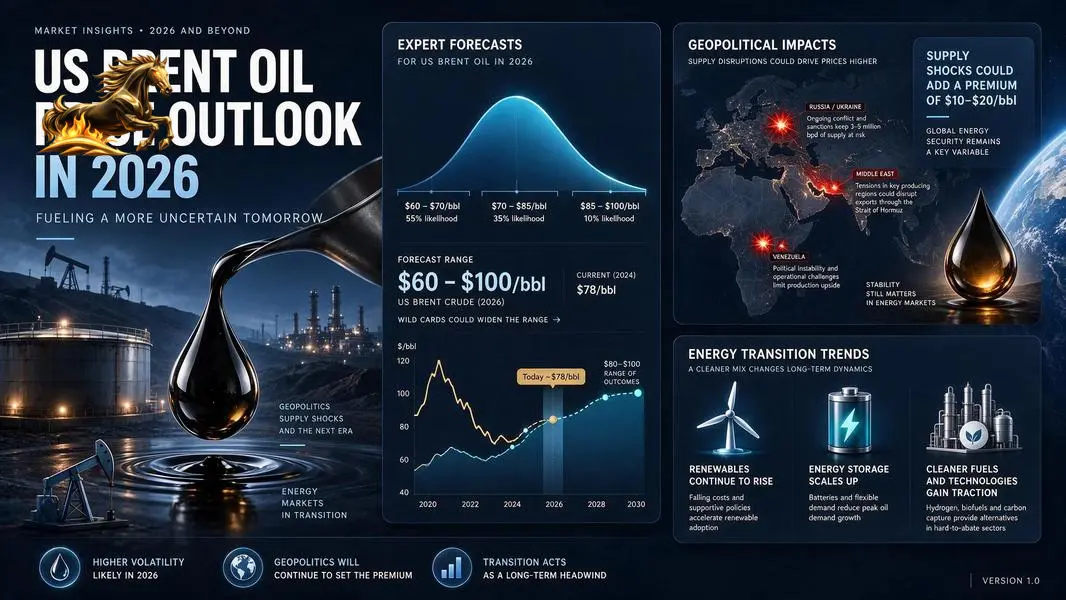
2026 Price Forecast: Three Scenarios
| Scenario | Catalysts | Price Range |
|---|---|---|
| Bull Case | Supply outages + strong GDP | $110-$130 |
| Base Case | Status quo volatility | $85-$105 |
| Bear Case | Recession + shale surge | $65-$80 |
Consensus view: Most banks forecast $92-$98 Brent averages for 2026.
Who Wins and Loses at $100 Brent?
Consumers & Businesses
- Pain at the pump: Every $10 rise adds ~$0.25/gallon to US gas prices.
- Inflation risk: Energy comprises 7-8% of CPI—Fed may delay rate cuts.
Investors
- Oil stocks (XOM, CVX): Thrive above $80 Brent.
- Clean energy plays: High oil prices boost renewables’ ROI.
Governments
- Petrostates (Saudi, UAE): Need $80+ to balance budgets.
- US shale: Still profitable even at $60—ready to flood market if prices spike.
5 Actionable Strategies for 2026
1️⃣ For Traders:
- Hedge with Brent/WTI spreads—they widen during crises.
- Watch ICE futures open interest for sentiment shifts.
2️⃣ Corporates:
- Lock in refinery margins with crack spread hedges.
- Shift logistics to rail/barge if diesel prices surge.
3️⃣ Consumers:
- Use gas price apps (GasBuddy) to time fill-ups.
- Consider hybrids if EVs remain costly.
4️⃣ Investors:
- Balance oil stocks with green energy ETFs (ICLN).
- Master the “contango/backwardation” cycle in futures.
5️⃣ Policymakers:
- Accelerate SPR releases only >$110 Brent.
- Subsidize energy efficiency programs proactively.
The Bottom Line
2026’s US Brent oil price will hinge on three narratives:
- Conflict vs. Stability in major producing regions.
- Energy Transition Pace—faster in the West, slower globally.
- Shale’s Ceiling Effect—US output can ramp up within months.
Volatility is guaranteed. Preparation is optional—but essential.
Pro Tip: Bookmark the EIA’s Short-Term Energy Outlook (STEO) for monthly forecast updates.
FAQ: Quick Answers
Q: Why does Brent trade above WTI?
A: Transport bottlenecks and global demand—Brent reflects overseas markets better.
Q: Could Brent hit $150 again?
A: Possible with a Middle East war, but shale would flood market within 6 months.
Q: How do I profit from oil volatility?
A: Energy ETFs (XLE), options strangles, or tanker stocks (FRO) during contango.
Q: Will EVs crash oil demand by 2030?
A: Not yet—global fleet turnover is slow. IEA still projects 103M bbl/day demand in 2030 (vs. 102M today).
Stay nimble, hedge smartly, and remember: in oil markets, the only certainty is surprise.
“`
