
body {
font-family: “Segoe UI”, Tahoma, Geneva, Verdana, sans-serif;
line-height: 1.6;
margin: 20px auto;
max-width: 900px;
color: #222;
background: #fdfdfd;
padding: 0 15px;
}
h1 {
font-size: 2.5rem;
color: #003366;
margin-bottom: 30px;
font-weight: 700;
}
h2 {
font-size: 1.8rem;
color: #00509e;
border-bottom: 2px solid #00509e;
padding-bottom: 8px;
margin-top: 40px;
margin-bottom: 20px;
}
h3 {
font-size: 1.4rem;
color: #0077cc;
margin-top: 30px;
margin-bottom: 12px;
}
p {
font-size: 1rem;
margin-bottom: 18px;
}
ul, ol {
margin: 15px 0 25px 30px;
font-size: 1rem;
color: #333;
}
strong {
color: #004080;
}
hr {
border: none;
border-top: 2px solid #00509e;
margin: 40px 0;
}
blockquote {
background: #e6f0ff;
padding: 15px 25px;
margin: 20px 0 30px 0;
border-left: 6px solid #00509e;
font-style: italic;
color: #003366;
}
.faq p {
margin: 6px 0 12px 0;
}
.faq strong {
color: #004080;
}
Brent Today: Your 2026 Guide to the Global Oil Benchmark and Its Real-World Impact
Imagine one number that steers what you pay at the gas pump, shapes shipping costs for your online orders, and influences decisions by central banks and global leaders alike. That number is the price of Brent today — the world’s premier oil benchmark in 2026. Whether you’re an investor, policymaker, or a household managing budgets, understanding Brent crude oil’s drivers is key to navigating today’s complex global economy.
Interestingly, “Brent” is also the name of a London borough grappling with rising food bank demand and housing insecurity. This dual meaning perfectly captures the reality: the seemingly distant world of oil trading has real, tangible effects on communities everywhere. Fluctuations in Brent crude ripple through economies, influencing daily living costs.
In this guide, we’ll dive into the Brent crude market of 2026, break down the key factors behind its pricing, and connect global trends to everyday impacts. By grasping Brent’s role today, you’ll better understand an energy-driven world in transition.
What Is Brent Crude Oil and Why Does It Matter in 2026?
Brent crude oil is a North Sea blend, sourced between the UK and Norway. Since the 1970s, it has set the global oil price standard due to its steady quality, consistent output, and geopolitical stability. When news outlets discuss “oil prices,” they usually mean Brent crude futures.
Today, Brent sets the benchmark price for nearly two-thirds of the world’s internationally traded crude oil. Oil from West Africa, the Mediterranean, or the Middle East is commonly priced as “Brent plus or minus a differential,” making Brent the baseline for comparing most other crude types.
In 2026, Brent’s role as the global benchmark continues but in a changing landscape. Its price now reflects a three-way tension among:
- Geopolitical Risks: Conflicts and instability in key producing regions and among global powers.
- Energy Transition: The shift toward renewables and electric transportation.
- Strategic Market Control: OPEC+ and other producer alliances balancing supply to manage prices.
Brent today symbolizes this tricky balance—a fossil fuel commodity split between traditional energy demands and a future leaning toward lower carbon alternatives.
Key point: Brent crude oil goes beyond fuel pricing—it’s a global economic indicator mirroring geopolitical shifts, technological advances, and environmental priorities.
The Current State of the Brent Market: Prices, Volatility, and Key Levels
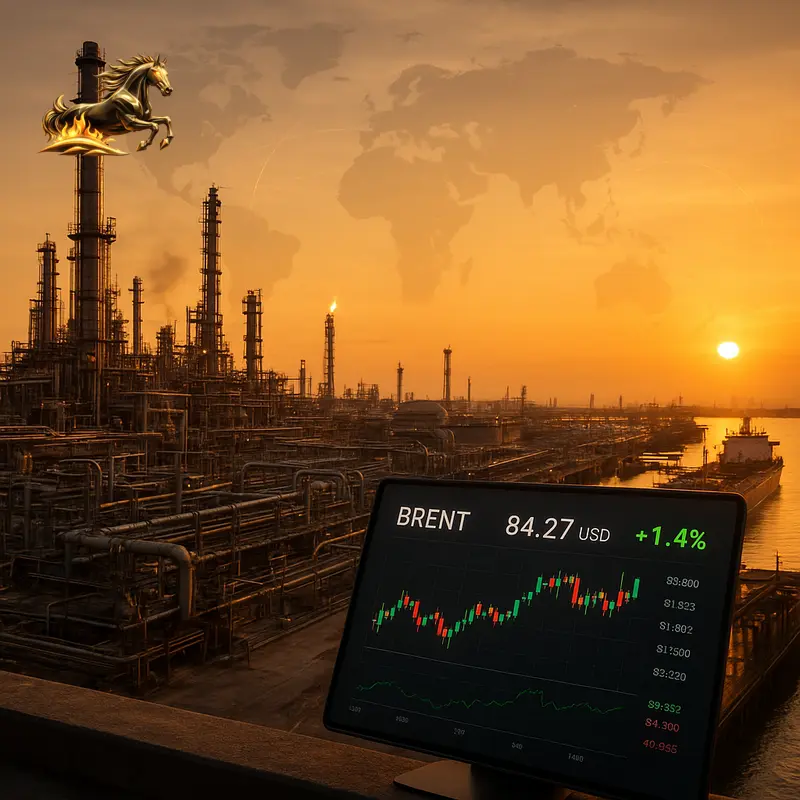
In 2026, Brent crude trades with notable volatility, mostly between $90 and $100 per barrel, reacting swiftly to geopolitical developments. Prices recently neared $97 a barrel amid regional unrest, highlighting how sensitive the market remains.
From a trading perspective, Brent prices hover near critical support and resistance levels, signaling a tight but cautious market constrained by concerns over long-term demand amid renewable adoption.
This price range matters because:
- Exporting countries like Saudi Arabia and Norway rely on these levels to sustain revenues and fund development.
- Importing nations face higher bills, driving inflation and complicating central bank policies.
- Businesses see fuel costs influencing transportation, manufacturing, and consumer goods prices worldwide.
Recall the recent spike over $120 per barrel during a surge in geopolitical risk—a clear reminder of Brent’s price vulnerability.
Brent of Two Worlds: Global Commodity Meets Local Community
Beyond oil markets, “Brent” also identifies a London borough struggling with rising social issues such as food bank usage and housing insecurity. This dual identity highlights how shifts in Brent crude prices are not just abstract numbers—they translate into real consequences for local lives and public policy.
Insight: Understanding Brent means recognizing how global markets touch community-level challenges.
The Primary Drivers of Brent Crude Prices in 2026
Four main forces shape Brent prices in 2026:
1. Geopolitical Tensions and Supply Risks
Ongoing conflicts—like Iran’s nuclear program, Middle East instability, and disruptions in Libya or Nigeria—keep supply uncertain. Even isolated events can trigger sharp price jumps over supply fears.
2. OPEC+ Coordination
The OPEC+ alliance, led by Saudi Arabia and Russia, carefully manages production. Their goal is a delicate balance: keep prices high enough to support national budgets without pushing them so high that global demand collapses or the energy transition accelerates.
3. Global Economic Health and Demand
Oil demand tracks closely with economic activity—strong growth in emerging markets like China and India sustains consumption, while recession threats temper it. Jet fuel and diesel demand signal health in travel and shipping sectors.
4. Energy Transition and Climate Policies
The rise of renewables, electric vehicles, carbon regulations, and divestment trends pressure long-term oil demand. Limited capital for fossil projects and innovations in alternatives increase Brent’s price volatility.
Summary: Brent’s price reflects a complex “trilemma” of geopolitical risks, economic trends, and accelerating energy transition.
Brent Prices and the Global Economy: The Ripple Effect
Brent crude prices influence the global economy profoundly:
- Inflation and Monetary Policy: Higher oil prices raise transportation and production costs, fueling inflation and prompting central banks to adjust interest rates.
- National Economies: Oil exporters gain through increased revenues and currency strength; importers face economic strain and inflationary pressure.
- Corporate Impact: Energy producers profit from rising prices, while transportation and consumer sectors deal with tighter margins and lower spending.
Bottom line: Brent price swings multiply through inflation, trade balances, corporate profits, and ultimately household budgets.
Case Study: Iran’s Diplomatic Influence on Brent Prices
Ongoing U.S.-Iran negotiations over sanctions offer a telling example:
- Diplomatic breakthroughs that allow Iranian oil back to market tend to lower Brent prices by increasing supply.
- Diplomatic deadlocks push prices up on anticipated shortages.
Market response depends on OPEC+ production moves, inventory levels, and demand from giants like China. Energy transition factors also shape long-term price impacts.
Lesson: Brent pricing dances between headlines, fundamentals, and structural shifts.
Looking Ahead: Trends Shaping Brent Crude Through the 2020s
Key trends shaping Brent’s future include:
- Peak Demand and a “Bumpy Plateau”: Oil use may peak this decade, then hover with ups and downs, as petrochemicals and hard-to-electrify sectors sustain consumption.
- Heightened Volatility: Declining investments and natural field depletion will cause cycles of scarcity and oversupply.
- OPEC+ Gaining Clout: As non-OPEC output decreases, OPEC+ influence grows, complicating market dynamics.
- Brent’s Evolution: The benchmark could expand to cover carbon pricing and new energy forms amid the transition.
Outlook: Brent will evolve along with the energy landscape—volatile, strategic, and hybrid.
Practical Implications: What Brent Means for You
For Individuals:
- Brace for periodic spikes in gasoline, heating, and goods costs.
- Invest in energy-efficient homes and electric vehicles.
- Use energy market insights to budget wisely.
For Business Leaders:
- Incorporate flexible pricing and hedging strategies.
- Prepare scenarios for oil price swings.
- Emphasize sustainability to lessen exposure.
For Policymakers and Citizens:
- Advance energy diversification and resilience.
- Support social safety nets for those hit hardest by energy inflation.
- Engage in informed debates on energy markets and local impacts.
Takeaway: Knowing Brent’s influence helps you make smarter choices—from finances to policy.
Conclusion: Navigating a Brent-Defined World
In 2026, Brent crude oil is more than a commodity—it’s a vital barometer linking geopolitics, economics, and the energy transition. As a bridge from traditional oil to emerging energy, Brent connects global supply dynamics to everyday community realities.
Staying informed about Brent today empowers better decisions—whether investing, planning business strategies, or engaging in public policy—guiding you through an energy future that is complex but navigable.
Frequently Asked Questions (FAQ)
Q1: What’s the difference between Brent and WTI crude oil?
Brent is a North Sea blend serving as the main global price reference, especially for Europe, Africa, and the Middle East. WTI (West Texas Intermediate) reflects U.S. supply and markets. Brent is more influenced by global geopolitics; WTI by U.S. production and infrastructure.
Q2: How do rising oil prices spur inflation?
Higher Brent prices raise transportation and production costs, pushing up goods and services prices worldwide, which feeds into inflation and central bank interest rate decisions.
Q3: If renewables are growing, why does oil remain critical?
Oil stays essential for aviation, shipping, and petrochemicals—sectors harder to electrify—keeping demand robust near term.
Q4: How does OPEC+ influence oil prices?
OPEC+ manages supply by adjusting production quotas, aiming to keep prices within ranges that support member economies without harming demand.
Q5: How can individuals protect against oil price swings?
Cut oil reliance by adopting energy-efficient practices, diversifying investments, staying updated on markets, and budgeting with price volatility in mind.
Understanding Brent crude oil today means grasping a crucial thread weaving through global economics and daily life. This knowledge prepares you not only for changes at the pump but for the broader energy shifts shaping our world’s future.
