
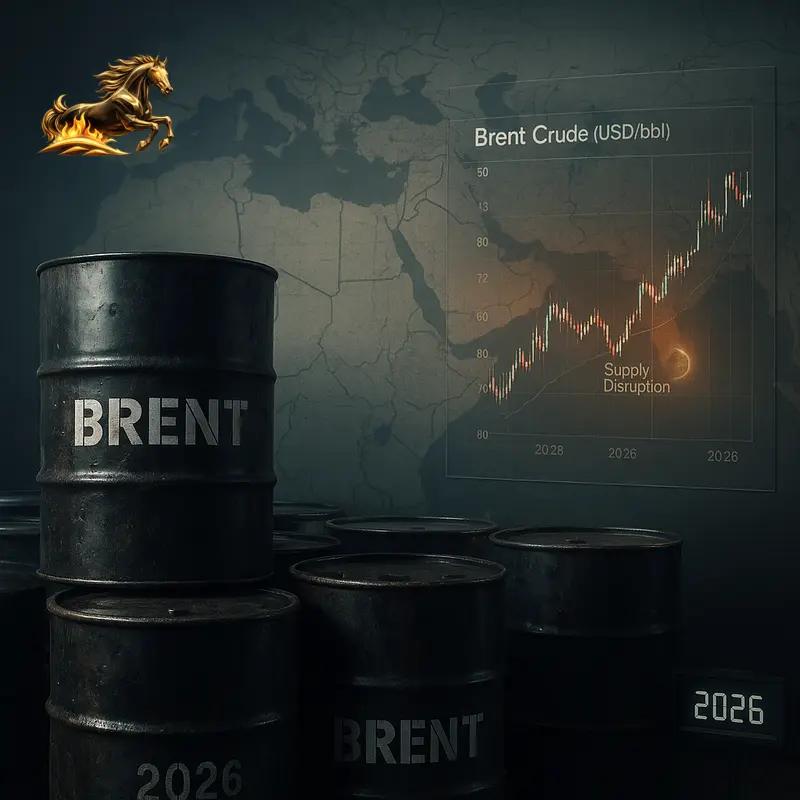
The Future of Brent Oil: Navigating Geopolitics, Supply, and Prices in 2026
Brent crude oil is far more than just a commodity price—it serves as a critical global indicator impacting fuel costs, economic stability, and international relations. As 2026 unfolds, Brent oil prices face unparalleled uncertainty. Escalated geopolitical tensions, especially in the Middle East, shifts within oil-producing cartels, and forecasts that point to sharp price climbs followed by potential declines characterize this volatile year.
For anyone involved in energy, finance, or global trade, understanding these forces is essential. This article dives deep into the complex factors shaping Brent crude this year—from geopolitical flashpoints affecting key supply routes, through structural changes among cartels, to official and market forecasts, and the ongoing evolution of the Brent benchmark itself.
Current Market Conditions: Elevated Prices Amid High Volatility
By mid-2026, Brent crude consistently trades above $110 per barrel, reflecting a market driven more by geopolitical risk than traditional supply-demand dynamics. Unlike prior cycles where inventories or global growth drove prices, the current backdrop is dominated by geopolitical events infusing a significant “war premium” into Brent.
Trading within a $107 to $112 range, prices fluctuate sharply in response to diplomatic shifts and military threats, highlighting the fragile market balance and the extreme difficulty of reliable price forecasting.
Key insight: The 2026 Brent oil market is fundamentally shaped by geopolitical tension overriding conventional market factors, requiring adaptable strategies that respond swiftly to sudden developments.
Geopolitics at the Helm: Conflict and Cartel Dynamics Shape Supply
Geopolitical tension steers the Brent oil outlook in 2026, anchored by two pivotal developments:
Renewed U.S.-Iran Conflict and Closure of the Strait of Hormuz
Ongoing hostilities between the U.S. and Iran have directly driven Brent prices upward. The Strait of Hormuz—a vital maritime chokepoint carrying roughly 20% of global oil—remains closed this year. This closure:
- Blocks millions of barrels daily from entering global markets, particularly Asia.
- Forces shipments to take longer, costlier alternative routes.
- Creates acute regional supply shortages reflected in rising Brent prices.
While diplomatic efforts intermittently offer hope, the physical supply disruption persists, embedding a sustained risk premium in Brent pricing.
UAE’s Departure from OPEC: A New Structural Challenge
The United Arab Emirates’ exit from OPEC adds complexity to global oil supply dynamics. This move:
- Dilutes OPEC’s ability to collectively manage production.
- Grants the UAE freedom to adjust output unilaterally, increasing supply volatility.
- Threatens the traditional Brent benchmark’s stability as a reliable supply reference.
Over time, this structural shift raises the stakes for greater price swings and diminished cartel influence on balancing supply.
Key insight: Geopolitical conflicts and cartel realignments are the chief causes of Brent’s 2026 price volatility, creating significant uncertainty regarding stable supply.
Official and Market Forecasts: Divergent Price Trajectories
Comparing official predictions with market sentiment reveals two contrasting paths:
EIA Forecast: Price Peak Followed by Decline
- The U.S. Energy Information Administration anticipates Brent prices peaking near $115 per barrel in Q2 2026 amid tight supply, then descending.
- An average price forecast of $96 per barrel for all of 2026—a 22% upward revision from earlier expectations.
- Prices dipping below $90 per barrel by Q4, contingent on reopening of the Strait of Hormuz and production normalization.
- A return near $76 per barrel in 2027, signaling market stabilization after a temporary supply crisis.
This scenario assumes a diplomatic breakthrough and gradual supply restoration.
Market Futures: Prolonged Elevated Prices
- By contrast, futures markets price in extended geopolitical risks.
- Brent futures near $111 per barrel towards the end of the quarter echo current high prices.
- Projections extending to $126 per barrel over the next 12 months reflect trader expectations of ongoing supply bottlenecks and instability.
This divergence underscores significant skepticism about a swift resolution.
Key insight: While the EIA outlook is cautiously optimistic, market pricing emphasizes persistent volatility, highlighting the need for preparedness for multiple possible outcomes.
The Brent-WTI Spread: A Barometer for Regional Supply Stress
- In March 2026, the Brent-WTI spread averaged $12 per barrel and is expected to widen to around $15 in April.
- This reflects heightened shipping costs and supply disruptions linked to the Strait of Hormuz closure relative to U.S.-sourced WTI.
- When the Strait reopens, the spread should narrow, signaling easing regional supply stress.
For market participants, tracking this spread is crucial for hedging decisions, refining economics, and spotting arbitrage opportunities.
Key insight: The Brent-WTI spread not only highlights immediate supply disruptions but also serves as an early signal for broader market normalization.
Brent Benchmark Evolution: Adapting to Changing Physical and Market Realities
In the face of geopolitical turmoil, the Brent benchmark itself is evolving. Declining output from original North Sea fields has prompted the inclusion of multiple oil grades in Brent’s pricing calculation. This adaptation:
- Preserves benchmark liquidity.
- Maintains Brent’s relevance as the global crude price reference amid shifting supply sources.
Though less headline-grabbing, this evolution is critical to sustaining market integrity and accurate price discovery.
Key insight: The Brent benchmark’s ongoing adaptation safeguards its role as a reliable market indicator despite systemic changes.
Broader Influences: Technology, Economy, and Renewable Energy
- Technological improvements slightly boost production efficiency, though their impact is overshadowed by supply disruptions.
- Economic policies influence demand patterns but are currently secondary to supply constraints.
- The renewable energy transition reduces long-term fossil fuel reliance, yet in 2026 this effect is muted against immediate geopolitical shocks.
Key insight: Technological advancements and economic factors remain relevant but are currently eclipsed by geopolitical supply challenges in shaping Brent’s short-term trajectory.
Future Scenarios and Strategic Recommendations
Looking ahead, three scenarios outline Brent’s 2026 path:
- Diplomatic Resolution: Conflict de-escalates, the Strait reopens, prices peak then stabilize, benefiting consumers and markets.
- Protracted Conflict: Persistent instability sustains high prices and supply constraints, prolonging market volatility.
- Escalation and Supply Shock: Worsening tensions disrupt infrastructure, trigger extreme price spikes, and shake the global economy.
Strategic takeaways:
- Financial actors should recalibrate hedging tactics to accommodate varied price scenarios and monitor benchmark spreads closely.
- Corporate consumers must adopt flexible contracts and prepare scenario-driven budgets.
- Analysts should integrate real-time geopolitical data and stress-test models with multiple crisis outcomes.
Key insight: Agility and preparedness are essential to navigate Brent’s volatile landscape through 2026.
Frequently Asked Questions (FAQ)
Q1: Why is Brent so sensitive to the Strait of Hormuz closure?
Because a significant portion of Middle East oil destined for Asia transits this narrow passage, its closure forces longer, costlier shipments, directly elevating Brent prices versus other benchmarks.
Q2: What does the UAE leaving OPEC mean for Brent prices?
It weakens OPEC’s production coordination, increasing the chance of unilateral supply decisions by the UAE and higher price volatility over time.
Q3: How reliable are EIA forecasts during current volatility?
The EIA provides a baseline scenario anticipating a resolution, but market pricing reflects broader uncertainties. Both perspectives should inform risk strategy.
Q4: What does a widening Brent-WTI spread indicate?
It signals regional supply disruptions centered around the Middle East, raising Brent prices relative to WTI and impacting refining and hedging strategies.
Q5: Will renewable energy trends lower Brent prices in 2026?
While renewables reduce fossil fuel reliance long-term, their impact is limited in 2026 due to pressing geopolitical supply disruptions and ongoing global oil demand.
Brent crude oil in 2026 is defined by intricate challenges and risks dominated by geopolitics. Successfully navigating this complex terrain requires informed adaptability and vigilance over evolving supply dynamics, market sentiment, and strategic fundamentals. With a clear understanding of these forces, stakeholders can better prepare for the uncertainties—and opportunities—this year holds.
