
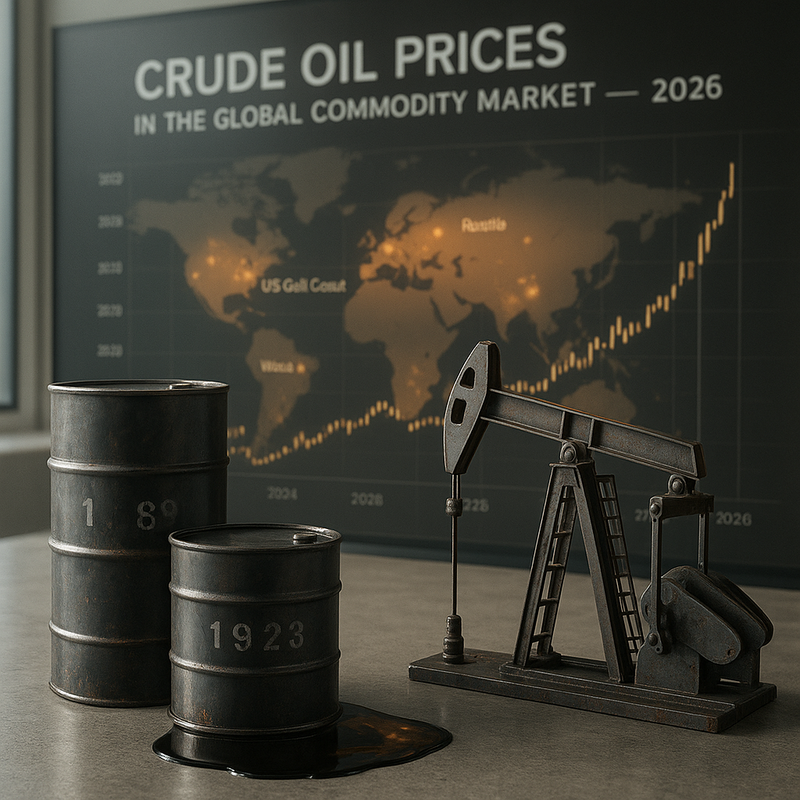
Understanding Crude Oil Prices in the Commodity Market:
Introduction
Crude oil stands as one of the most vital commodities shaping the global economy, influencing everything from transportation costs to consumer goods prices. As 2026 advances, grasping the key drivers behind crude oil prices is essential for investors, businesses, and policymakers. This blog offers a clear, insightful look into the forces shaping crude oil prices today, highlights recent market trends, and provides a forecast for what lies ahead.
The Significance of Crude Oil in the Global Economy
Nicknamed “black gold,” crude oil serves as a cornerstone energy source for industrialized societies worldwide. According to the International Energy Agency (IEA), oil demand continues to rise, especially in emerging economies where industrial growth fuels energy needs. For instance, global oil demand in 2025 is expected to surpass 105 million barrels per day (bpd)—a historic milestone. However, driven by energy transition efforts and efficiency gains, demand is projected to stabilize throughout 2026.
Key Statistics:
- Projected global oil demand in 2025: over 105 million barrels per day
- Oil revenues may account for up to 15% of the global GDP in 2026
Recognizing crude oil’s economic importance highlights why its price mechanisms deserve close attention.
How Prices Are Set in the Oil Market
Crude oil prices are determined in a complex global marketplace, primarily benchmarked by:
- West Texas Intermediate (WTI): The dominant price index in North America
- Brent Crude: The global reference price influencing international markets
Pricing depends on supply-demand balance but is also highly sensitive to factors such as:
- Geopolitical tensions disrupting supply or logistics
- OPEC policies and production quotas
- Natural disasters affecting extraction and distribution
- Economic indicators signaling demand shifts
For example, geopolitical conflicts in the Middle East during March 2025 led to a roughly 30% surge in oil prices, underscoring the market’s sensitivity to geopolitical events.
Current Trends in Crude Oil Pricing
Analyzing the crude oil market in 2026 reveals several prominent pricing trends:
1. Energy Transition and Sustainability
Global momentum towards reducing carbon footprints through renewable energy adoption introduces uncertainty in crude oil demand. While renewables may limit growth, the pace of transition and regional dependency on oil vary greatly.
2. Increased Production Capabilities
Technological advances like hydraulic fracturing and enhanced oil recovery have enabled producers—especially in the U.S.—to increase output substantially. This boost in supply can exert downward pressure on prices when demand softens.
3. Economic Growth and Recovery
With economies rebounding from recent disruptions, heightened industrial and transport activity propels oil consumption. The World Bank forecasts 4% global economic growth in 2026, a key driver for energy demand.
Together, these trends create a dynamic market shaped by shifting supply and demand.
The Role of OPEC in the Crude Market
The Organization of the Petroleum Exporting Countries (OPEC) continues to play a pivotal role in managing crude oil supply and price stability. Through coordinated production adjustments—with allies in the OPEC+ alliance—OPEC responds to supply imbalances.
For instance, in early 2026, OPEC cut output by about one million barrels per day to curb oversupply, helping stabilize prices near $80 per barrel. This move highlights OPEC’s sustained influence on market balance and investor confidence.
The Impact of Speculation
Speculative trading significantly impacts oil prices, with investors buying and selling futures based on anticipated price moves. While speculation provides market liquidity, it can also lead to amplified price swings.
In December 2025, speculative activity pushed WTI prices to $95 per barrel despite stable supply-demand fundamentals, demonstrating market volatility driven by investor sentiment.
The Impact of Inflation
Inflation influences crude oil prices by affecting production and operational costs, which in turn alters prices paid by consumers and businesses. For example, inflation in developed nations reached 5.5% in 2025, raising concerns over increased oil production expenses and their price impacts.
Future Outlook on Crude Oil Prices
Looking ahead beyond 2026, several scenarios could emerge:
1. Continued Volatility
Persistent geopolitical risks, regulatory changes, and economic uncertainties suggest price volatility will remain. Experts predict oil may trade between $70 and $90 per barrel in the near term.
2. Shift to Alternative Energy
As renewable energy adoption grows and carbon reduction commitments strengthen, crude oil demand could decline. Projections indicate a potential 5% decrease by 2030, signaling a gradual transition.
3. Technological Innovations
Advancements in battery tech, electric vehicles, and sustainable fuels will challenge crude oil’s dominance. Electric vehicle sales could triple by 2030, further reducing oil demand in transportation.
These forces point to a transformational era ahead for crude oil markets.
Conclusion
The crude oil market in 2026 is a complex interplay of geopolitics, technology, economic growth, and sustainability efforts. Understanding these drivers is crucial for anyone seeking to navigate this volatile commodity market confidently.
Key Takeaways
- Crude oil prices reflect a multifaceted mix of supply-demand, geopolitical events, OPEC decisions, and speculative trading.
- OPEC remains a key player in stabilizing supply and prices.
- The global energy transition suggests long-term moderation or decline in crude oil demand.
Suggested Next Steps
- Stay Updated: Follow market insights from the IEA, EIA, OPEC, and industry experts.
- Diversify Investments: Explore renewable energy and innovative technology sectors.
- Deepen Understanding: Engage with market analysis and commodity trading education to sharpen your edge.
Staying informed about these evolving trends empowers investors, businesses, and policymakers to anticipate changes and make smart decisions in the crude oil commodity market.
