
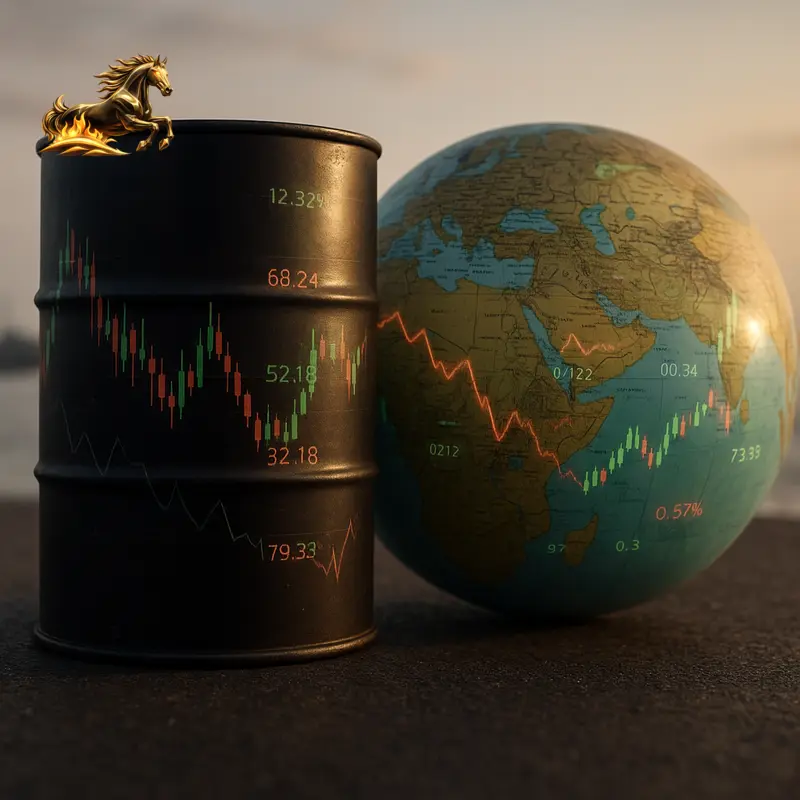
Crude Oil Per Barrel in 2026: Navigating a World of Conflict and Shortage
The crude oil price per barrel in 2026 goes beyond mere numbers—it’s a reflection of a fragile global economy strained by geopolitical tensions and tangible supply shortages. With weekly price swings sometimes hitting 7% and a supply gap estimated between 7 to 11 million barrels per day, grasping the factors behind oil pricing has never been more critical. This article breaks down the key drivers behind crude oil prices in 2026, explores their economic impact, and equips you with strategies to navigate one of the most unpredictable markets in recent memory.
The Current State of Crude Oil Prices: A Market on Edge
By May 2026, crude oil prices are marked by sharp volatility and elevated levels. West Texas Intermediate (WTI) and Brent Crude provide crucial signals of this fragility.
WTI soared to $95.92 per barrel on May 8th, triggered by U.S. military strikes targeting Iranian sites following attacks on American naval vessels in the Strait of Hormuz. This surge unfolds alongside cautious optimism as former President Trump voiced hopes for a ceasefire—capturing the 2026 market’s balance between conflict and diplomacy. Despite a slight pullback over the month, WTI is up more than 57% for the year, highlighting sustained upward price pressure.
Brent Crude’s story is equally volatile, spiking to $111 per barrel after diplomatic talks over the Strait of Hormuz collapsed. Iran’s offer to reopen this critical waterway without nuclear concessions was rejected, leaving the market unsettled as closure fears threaten to cut roughly 14 million barrels daily from global supply.
The Physical Shortage Driving Prices
Underpinning these price moves is a stark reality: an actual global crude oil supply shortage estimated between 7 and 11 million barrels per day. This crunch is apparent as major refiners, like Reliance, pay premiums of $30 to $40 per barrel above benchmark prices to secure shipments. The current backwardation—where spot prices outpace futures—signals trader expectations that this shortage may be severe but possibly short-lived within the next two months. However, if disruptions linger, prices could average $110 per barrel in Q2 2026, with spikes potentially hitting $120 per barrel.
Key takeaway: Geopolitical conflict combined with genuine supply deficits has created an exceptionally tense pricing environment in 2026.
Core Drivers of Volatility in 2026
Multiple critical factors explain the extreme volatility in crude oil prices this year:
Geopolitical Conflict: The Strait of Hormuz as the Epicenter
The Strait of Hormuz remains the world’s most crucial oil chokepoint, funneling about 14 million barrels daily—30% of all global seaborne oil trade. Recent developments have escalated tensions sharply:
- U.S.-Iran military clashes raise the risk of a full closure.
- Iran’s proposal to reopen the strait without nuclear concessions was rejected, stalling diplomatic progress.
- The International Energy Agency warns that this instability could cause prolonged production losses across Gulf Cooperation Council nations.
Weekly market moves of up to 7% reflect traders struggling to interpret rapidly changing geopolitical signals, underscoring extreme market sensitivity.
Supply Disruption and Inventory Drawdowns
Supply constraints are no longer hypothetical. Global crude inventories are dipping steadily:
- U.S. crude stocks have declined for eight straight weeks.
- Gasoline and distillate inventories have also fallen for multiple weeks, signaling downstream fuel market stress.
These trends confirm that the supply shortage is real and ongoing, pushing refiners to pay high premiums and thus elevating crude oil prices per barrel.
Market Speculation and Sentiment
Uncertainty fuels speculative activity. Traders react instantly to any military actions, diplomatic statements, or regional unrest, intensifying price volatility. Navigating this requires interpreting both immediate supply-demand fundamentals and longer-term forecasts of conflict or resolution.
Summary: The 2026 crude oil market’s volatility stems from the intersection of geopolitical turmoil, actual supply shortages, and speculative dynamics.
Economic Implications of Rising Oil Prices
Inflation and Consumer Expenses
Oil fuels essential sectors—transportation, manufacturing, heating, and power generation. As prices climb:
- Transportation and shipping costs surge.
- Manufacturing becomes more expensive due to rising petrochemical and energy inputs.
- Consumers confront higher prices at the pump and increased utility bills.
Given ongoing inventory drawdowns, inflationary pressures are already intensifying and could worsen if supply constraints persist.
National Budgets and Trade Balances
For oil-importing countries, rising prices strain budgets and trade deficits, potentially forcing tough fiscal decisions. Exporters reap higher revenues but face elevated political and operational risks amid ongoing conflicts.
Energy Policy and Strategic Shifts
The current crisis is accelerating two critical policy trends:
- Urgent diversification of energy sources and supply routes to reduce Persian Gulf dependence.
- Renewed emphasis on energy transition toward renewables and electrification, driven by vulnerabilities revealed during this turmoil.
Insight: Soaring oil prices in 2026 are both a challenge and a catalyst for structural energy changes worldwide.
Strategies to Navigate the 2026 Oil Market
Managing risk and capitalizing on opportunities requires informed action.
For Investors and Traders
- Monitor inventory levels and refining premiums for concrete supply insights.
- Analyze backwardation to anticipate potential relief timelines.
- Develop nuanced geopolitical frameworks to interpret unfolding events accurately.
For Corporate Management
- Hedge fuel purchases proactively to limit exposure and stabilize costs.
- Build strategic inventory buffers where possible.
- Run scenario analyses covering a range of price outcomes to ensure resilience.
For Policymakers
- Intensify diplomatic efforts to reopen the Strait of Hormuz.
- Use strategic petroleum reserves sparingly to alleviate market pressures.
- Promote diversification in energy sources and supply routes to reduce systemic risk.
Practical advice: Stay proactive with data, planning, and policy to mitigate risks amid today’s challenging energy landscape.
Outlook: Possible Oil Price Scenarios for the Rest of 2026
Future prices depend heavily on diplomatic and geopolitical developments, especially around the Persian Gulf.
Scenario 1: Swift Diplomatic Resolution (Most Likely)
A negotiated reopening of the Strait and de-escalation would ease shortages. Prices could stabilize between $85 and $100 per barrel as inventories rebuild.
Scenario 2: Prolonged Partial Disruption
Continued instability maintaining tight supplies would keep premiums high. Q2 prices may average $110 per barrel, extending inflationary and supply pressures.
Scenario 3: Full Closure (Low Probability, High Impact)
A total, long-term closure—which remains unlikely—could remove 14 million barrels daily from the market. Prices could spike past $120 per barrel, triggering severe global economic disruption.
In brief: While diplomacy offers hope for easing crude oil prices, preparing for less favorable scenarios is essential.
Key Takeaways and Practical Recommendations
The 2026 crude oil saga highlights the deep connection between geopolitical stability and commodity prices. Remember:
- Geopolitical conflict around the Strait of Hormuz drives extreme price swings.
- A tangible physical shortage forces refiners to pay steep premiums.
- Market signals point to potential short-term relief but remain fragile.
- Economic impacts are already visible in rising consumer and industrial costs.
- Preparedness across scenarios is vital for all market players.
Next steps:
- Follow trusted, data-driven sources combining market and geopolitical insight.
- Evaluate your exposure to oil price volatility.
- Develop contingency plans for various pricing scenarios.
- Support energy diversification initiatives to build greater resilience.
By understanding the forces shaping crude oil prices per barrel in 2026, investors, businesses, and policymakers can navigate this volatile market with insight and confidence.
FAQ: Crude Oil Per Barrel in 2026
- Q1: Why are crude oil prices so high and volatile in 2026?
- Because of a real supply shortage of 7–11 million barrels per day compounded by intense geopolitical risks centered on the Strait of Hormuz, prices fluctuate sharply in response to evolving conflicts and diplomatic efforts.
- Q2: Why is the Strait of Hormuz critical to oil prices?
- This narrow passage handles about 30% of global seaborne oil trade; any disruption drastically cuts supply, immediately pushing prices higher.
- Q3: What is backwardation, and why does it matter now?
- Backwardation occurs when current spot prices exceed future prices, indicating trader confidence that tight supply is temporary and will ease shortly.
- Q4: How do rising oil prices affect everyday consumers and the broader economy?
- Higher oil costs increase transport, manufacturing, and heating expenses, leading to higher consumer prices and inflationary pressure.
- Q5: What is the oil price outlook for the rest of 2026?
- Prices may stabilize around $85–$100 per barrel with diplomatic progress, rise to $110 with ongoing disruption, or spike beyond $120 if a full closure occurs.
